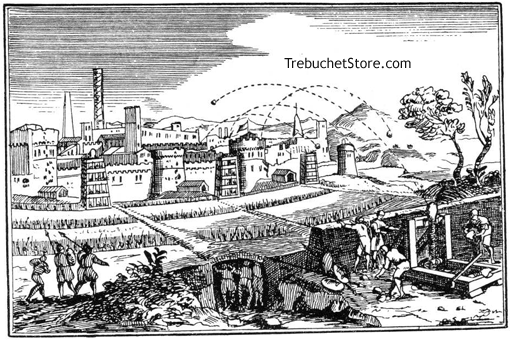
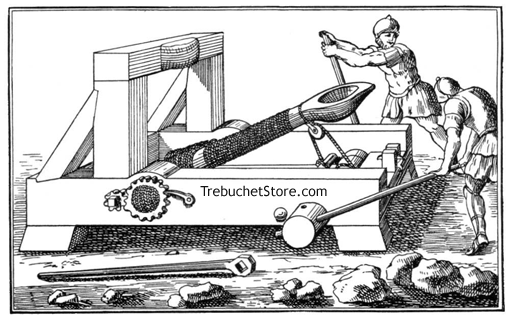
INTRODUCTORY NOTES trebuchet, however large, as worked merely by a counterpoise, and that of an engine deriving its power from the elasticity of an immense coil of tightly twisted sinew. It is certain that if the latter kind of engine had survived in its perfect state the introduction of cannon would have been considerably delayed, for the effects in warfare of the early cannon were for a long period decidedly inferior to those of the best projectile engines of the ancients. Notwithstanding many difficulties, I have succeeded in reconstructing, though of course on a considerably smaller scale, the chief projectile throwing engines of the ancients, and with a success that enables them to compare favorably, as regards their range, with the Greek and Roman weapons, they represent. Still, my engines are by no means perfect in their mechanism, and are, besides, always liable to give way under the strain of working. One reason of this is that all modern engines of the kind require to be worked to their utmost capacity, i.e. to the verge of their breaking point, to obtain from them results that at all equal those of their prototypes. A marked difference between the ancient engines and their modern imitations, however excellent the latter may be, is, that the former did their work easily, and well within their strength, and thus without any excessive strain which might cause their collapse after a short length of service.1 The oft-disputed question as to the distance to which catapults and ballistas shot their projectiles can be solved with approximate accuracy by comparing their performances as given by ancient military writers with the results obtainable from modern reproductions. While treating of this matter we should carefully consider the position and surroundings of the engines when engaged in a siege, and especially the work for which they were designed. As an example, archers, with the advantage of being stationed on high towers and battlements, would be well able to shoot arrows from 270 to 280 yards. For this reason it was necessary for the safe manipulation of the attacking engines that they should be placed at about 300 yards from the outer walls of any fortress they were assailing. As a catapult or a ballista was required not only to cast its missile among the soldiers on the ramparts of a fortified place, but also to send it clear over the walls amid the houses and people within the defenses, it is evident that the 1 Again, though my largest catapult will throw a stone to a great distance it cannot throw one of nearly the weight it should be able to do, considering the size of its frame, skein of cord and mechanism. In this respect it is decidedly inferior to the ancient engine. 8 INTRODUCTORY NOTES engines must have had a range of from 400 to 500 yards, or more, to be as serviceable and destructive as they undoubtedly were. Josephus tells us that at the siege of Jerusalem, A.D. 70 ("Wars of the Jews," Book V. Chapter VI.), stones weighing a talent (57 0 lbs. avoirdupois) were thrown by the catapults to a distance of two or more "stades." This statement may be taken as trustworthy, for Josephus relates what he personally witnessed and his comments are those of a commander of high rank and intelligence. Two or more "stades," or let us say 2 to 2 0 "stades," represent 400 to 450 yards. Remarkable and conclusive testimony confirming the truth of what
we read in Josephus is the face that my largest catapult though doubtless much smaller and less powerful than those referred to by the historian throws a stone ball of 8 lbs. in weight to a range of from 450 to nearly 500 yards. It is easy to realize that the ancients, with their great and perfect engines fitted with skeins of sinew, could cast a far heavier stone than one of 8 lbs., and to a longer distance than 500 yards. 9 INTRODUCTORY NOTES Agesistratus,1 a Greek writer who flourished B.C. 200, and who wrote a treatise on making arms for war, estimated that some of the engines shot from 3 . to 4 "stades" (700 to 800 yards). Though such a very long flight as this appears almost incredible, I can adduce no sound reason for doubting its possibility. From recent experiments I am confident I could now build an engine of a size and power to accomplish such a feat if light missiles were used, and if its cost were not a consideration.
1 The writings of Agesistratus are non-extant but are quoted by Atheneus. 10 The Projectile Throwing Engines of The Ancients Design, Construction and Operation of Ancient Greek, Roman and Medieval Siege Engines and Their Effects In Warfare
Written by Sir Ralph Payne-Gallwey in 1907,this is the first serious modern work on ancient siege engines and the early history of artillery. In this book, Payne-Gallwey first cites the ancient writings of Greeks and Romans on sieges and the associated artillery. In order to test the validity of the ancient accounts, he produces his own full size working versions of these ancient machines and tests the construction and performance claims of the ancient writers. Fully illustrated, this book gives extensive details about the design, construction, operation and performance of the three types of siege engines: the Catapult (both the Mangonel and Onager), the Ballista and the Trebuchet.
History of The Catapult - Catapult Facts
|
|||||||||||||||||||||||||||||||||||||||||||||||||||||||||||||||||||||||||||||||||||||||||||||||||||||||||||||||||||||||||||||||||||||||||||||||||||||||||||||||||||||||