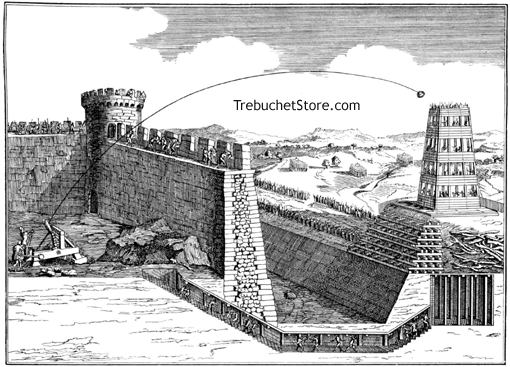
It is, indeed, impossible to find a complete working plan of any one of these old weapons, a perfect design being only obtainable by consulting many ancient authorities, and, it may be said, piecing together the details of construction they individually give. We have no direct evidence as to when the engines for throwing projectiles were invented. It does not appear that King Shalmaneser II. of Assyria (859-825 B.C.) had any, for none are depicted on the bonze doors of the palace of Baliwat, now in the British Museum, on which his campaigns are represented, though his other weapons of attack and defense are clearly shown. The earliest allusion is the one in the Bible, where we read of Uzziah, who reigned from B.C. 808-9 to B.C. 756-7. 'Uzziah made in Jerusalem engines invented by cunning men, to be on the towers and upon the bulwarks, to shoot arrows and great stones withal.' (2 Chronicles xxvi. 15.) Diodorus tells us that the engines were first seen about 400 B.C., and that when Dionysisu of Syracuse organized his great expedition against the Carthaginians (397 B.C.) there was a genius among the experts collected from all over the world, and that this man designed the engines that cast stones and javelins. From the reign of Dionysius and for many subsequent centuries, or till near the close of the fourteenth, projectile-throwing engines are constantly mentioned by military historians. But it was not till the reign of Philip of Macedon (360-336 B.C.) and that of his son Alexander the Great (336-323 B.C.) that their improvement was carefully attended to and their value in warfare fully recognized. As before stated, the Romans adopted the engines from the Greeks. Vitruvius and other historians tell us this, and even copy their descriptions of them from the Greek authors, though too often with palpable inaccuracy. To ascertain the power and mechanism of these ancient engines a very close study of all the old authors who wrote about them is essential, with a view to extracting here and there useful facts amid what are generally verbose and confused references. There is no doubt that the engines made and used by the Romans after their conquest of Greece (B.C. 146), in the course of two or three centuries became inferior to the original machines previously constructed by the Greek artificers.There efficiency chiefly suffered because the art of manufacturing their important parts was gradually neglected and allowed to become lost. 5
6 INTRODUCTORY NOTES For instance, how to make the skein of sinew that bestowed the very life and existence on every projectile-casting engine of the ancients. The tendons of which the sinew was composed, the animals from which it was taken, and the manner in which it was prepared, we can never learn now. Every kind of sinew, or hair or ropes, with which I have experimented, either breaks or loses its elasticity in a comparatively short time, if great pressure is applied. It has then to be renewed at no small outlay of expense and trouble. Rope skeins, with which we are obliged to fit our models, cannot possibly equal in strength and above all in elasticity, skeins of animal sinew or even of hair. The formation of the arm or arms of an engine, whether it is a catapult with its single upright arm or a ballista with its pair of lateral ones is another difficulty which cannot now be overcome, for we have no idea how these arms were made to sustain the great strain they had to endure. We know that the arm of a large engine was composed of several spars of wood and lengths of thick sinew fitted longitudinally, and then bound round with broad strips of raw hide which would afterwards set nearly as hard and tight as a sheath of metal. We know this, but we do not know the secret of making a light and flexible arm of sufficient strength to bear such a strain as was formerly applied to it in a catapult or a ballista. Certainly, by shaping an arm of great thickness we can produce one that will not fracture, but substance implies weight, and undue weight prevents the arm from acting with the speed requisite to cast its projectile with good effect. A heavy and ponderous arm of solid wood cannot, of course, rival in lightness and effectiveness a composite one of wood, sinew and hide. The former is necessarily inert and slow in its action of slinging a stone, while the latter would, in comparison, be as quick and lively as a steel spring. When the art of producing the perfected machines of the Greeks was lost, they were replaced by less effective contrivances. If the knowledge of constructing the great catapult of the ancients in its original perfection had been retained, such a clumsy engine as the medieval trebuchet would never have gained popularity. The trebuchet derived its power from the gravity of an immense weight at one end of its pivoted arm tipping up the other end, to which a sling was attached for throwing a stone. As regards range, there could be no comparison between the efficiency of a 7 The Projectile Throwing Engines of The Ancients Design, Construction and Operation of Ancient Greek, Roman and Medieval Siege Engines and Their Effects In Warfare
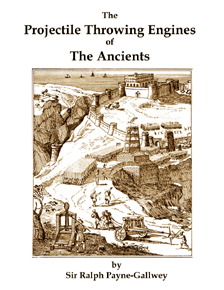
Written by Sir Ralph Payne-Gallwey in 1907,this is the first serious modern work on ancient siege engines and the early history of artillery. In this book, Payne-Gallwey first cites the ancient writings of Greeks and Romans on sieges and the associated artillery. In order to test the validity of the ancient accounts, he produces his own full size working versions of these ancient machines and tests the construction and performance claims of the ancient writers. Fully illustrated, this book gives extensive details about the design, construction, operation and performance of the three types of siege engines: the Catapult (both the Mangonel and Onager), the Ballista and the Trebuchet.
Catapult History - Ancient Roman Catapults
|
|||||||||||||||||||||||||||||||||||||||||||||||||||||||||||||||||||||||||||||||||||||||||||||||||||||||||||||||||||||||||||||||||||||||||||||||||||||||||||||||||||||||