HISTORICAL NOTES ON ANCIENT AND MEDIEVAL SIEGEENGINES AND THEIR EFFECTS IN WARFARE IT is evident that a history of ancient siege engines cannot be created de novo. All that can be done is to quote with running criticism what has been written about them. The first mention of ballistas and catapults is to be found in the Old Testament, two allusions to these weapons being made therein. The references are : 2 Chronicles xxvii.15, 'And he1 made in Jerusalem engines, invented by cunning men, to be on the towers and upon the bulwarks, to shoot arrows and great stones withal.' Ezekiel xxvi. 9, 'And he shall set engines of war against thy walls'. Through the latter extract is not so positive in its wording as the one first given, it undoubtedly refers to engines that cast either stones or arrows against the walls, especially as the prophet previously alludes to other means of assault. One of the most authentic descriptions of the use of the great missive engines is to be found in the account by Plutarch of the siege of Syracuse by the Romans 214-212 B.C. Cesar in his Commentaries on the Gallic and Civil wars, B.C. 58-50, frequently mentions the engines which accompanied him in his expeditions. The ballistas on wheels were harnessed to mules and called carro-ballistas. The carro-ballista discharged its heavy arrow over the head of the animal to which the shafts of the engine were attached. Among the ancients these carro-ballistas acted as field artillery and one is plainly shown in use on Trajan's Column. According to Vegetius, every cohort was equipped with one catapult and every century with one carro-ballista ; eleven soldiers being required to work the latter engine. 1Uzziah. 31
32 HISTORICAL NOTES Sixty carro-ballistas accompanied, therefore, besides ten catapults, a legion. The catapults were drawn along with the army on great carts yoked to oxen. In the battles and sieges sculptured on Trajan's Column there are several figures of ballistas and catapults. This splendid monument was erected in Rome, 105-113, to commemorate the victories of Trajan over the Dacians, and constitutes a pictorial record in carved stone contain some 2,500 figures of men and horses. It is astonishing what a large number of catapults and ballistas were sometimes used in a siege. For instance, at the conquest of Carthage, B.C. 146, 120 great catapults and 200 small ones were taken from the defenders, besides 33great ballistas and 52 small ones (Livy).1 Abulfaragio (Arab historian, 1226-1286) records that at the siege of Acre in 1191, 300 catapults and ballistas were employed by Richard I. and Philip II. Abbo, a monk of Saint German des Pris, in his poetic but very detailed account of the siege of Paris by thee Northmen in 885, 886, writes 'that the besieged had a hundred catapults on the walls of the town'.2 Among our earlier English King's Edward I. was the best versed in projectile weapons large and small, including crossbows and longbows. In the Calendar of Documents relating to Scotland, an account is given of his 'War-wolf,' a siege engine in the construction of which he was much interested and which was no doubt a trebuchet. This machine was of immense strength and size, and took fifty carpenters and five foremen a long time to complete. Edward designed it for the siege of Stirling, whither its parts were sent by land and by sea. Sir Walter de Bedewyne, writing to a friend on July 20, 1304 (see Calendar of State Documents relating to Scotland), says : 'As for news, Stirling Castle was absolutely surrendered to the king without conditions this Monday, St. Margaret's Day, but the King wills it that none of his people enter the castle till it is struck with his “War-wolf,†and that those within the castle defend themselves from the said “War-wolf†as best they can.' From this it is evident that Edward, having constructed his 'War-wolf' to cast heavy stones into the castle of Stirling to induce its garrison to surrender was much disappointed by their capitulation before he had an opportunity of testing the power of his new weapon. 1 Just previous to the famous defense of Carthage, the Carthaginians surrendered to the Romans 'two hundred thousand suits of amour and a countless number of arrows and javelins, besides catapults for shooting swift bolts and for throwing stones to the number of two thousand.' From Appian of Alexandria, a Greek writer who flourished 98-161. 2 These were probably ballistas, as Ammianus Marcellinus writes of the catapult, 'An engine of this kind placed on a stone wall shatters whatever is beneath it, not by its weight but by the violence of its shock when discharged.' 33 The Projectile Throwing Engines of The Ancients Design, Construction and Operation of Ancient Greek, Roman and Medieval Siege Engines and Their Effects In Warfare
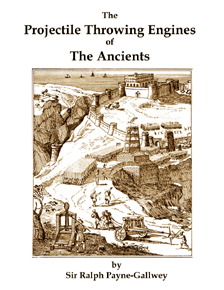
Written by Sir Ralph Payne-Gallwey in 1907,this is the first serious modern work on ancient siege engines and the early history of artillery. In this book, Payne-Gallwey first cites the ancient writings of Greeks and Romans on sieges and the associated artillery. In order to test the validity of the ancient accounts, he produces his own full size working versions of these ancient machines and tests the construction and performance claims of the ancient writers. Fully illustrated, this book gives extensive details about the design, construction, operation and performance of the three types of siege engines: the Catapult (both the Mangonel and Onager), the Ballista and the Trebuchet.
Catapult History - History of Roman and English Catapults
|
|||||||||||||||||||||||||||||||||||||||||||||||||||||||||||||||||||||||||||||||||||||||||||||||||||||||||||||||||||||||||||||||||||||||||||||||||||||||||||||||||||||||