HISTORICAL NOTES One of the last occasions on which the trebuchet was used with success is described by Guillet in his "Life of Mahomet II."1 This author writes : "At the siege of Rhodes in 1480, the Turks set up a battery of sixteen great cannon, but the Christians successfully opposed the cannon with a counter battery of a new invention.2 "An engineer, aided by the most skillful carpenters in the besieged town, made an engine that cast pieces of stone of a terrible size. The execution wrought by this engine prevented the enemy from pushing forward the work of their approaches, destroyed their breastworks, discovered their mines, and filled with carnage the troops that came within range of it." At the siege of Mexico by Cortes in 1521, when the ammunition for the Spanish cannon ran short, a soldier with a knowledge of engineering undertook to make a trebuchet that would cause the town to surrender. A huge engine was constructed, but on its first trial the rock with which it was charged instead of flying into the town ascended straight upwards, and falling back to its starting-point destroyed the mechanism of the machine itself.3 Though all the projectile engines worked by cords and weights disappeared from continental warfare when cannon came to the front in a more or less improved form, they--if Vincent le Blanc is to be credited--survived in barbaric nations long after they were discarded in Europe. This author (in his travels in Abyssinia) writes "that in 1576 the Negus attacked Tamar, a strong town defended by high walls, and that the besieged had engines composed of great pieces of wood which were wound up by cords and screwed wheels, and which unwound with a force that would shatter a vessel, this being the cause why the Negus did not assault the town after he had dug a trench round it".4 Plutarch, in his Life of Marcellus the Roman General, gives a graphic account of Archimedes and the engines this famous mathematician employed in the defense of Syracuse. It appears that Archimedes showed his relative Hiero II., King of Syracuse, some wonderful examples of the way in which immense weights could be moved by a combination of levers. 1 Guillet de Saint George, born about 1625, died 1705. His Life of Mahomet II. Was published in 1681. He was the author of several other works, including one on riding, warfare and navigation, termed the Gentleman"s Dictionary. The best edition of this book is in English and has many very curious illustrations. It is dated 1705. 2 Called a new invention because the old siege engine of which this one (probably a trebuchet) was a reproduction had previously been laid aside for many years. 3 Conquest of Mexico. W. Prescott, 1843. 4 Vincent le Blanc, Voyages aux quatre parties du monde, redig. par Bergeron, Paris,1649. Though the account given by this author of his travels are imaginative, I consider his allusion to the siege engine to be trustworthy, as he was not likely to invent so correct a description of one. 34 HISTORICAL NOTES Hiero, being greatly impressed by these experiments, entreated Archimedes temporarily to employ his genius in designing articles of practical use, with the result that the scientist constructed for the king all manner of engines suitable for siege warfare. Though Hiero did not require the machines, his reign being a peaceful one, they proved of great value shortly after his death when Syracuse was besieged by the Romans under Marcellus, 214-212. B.C. On this occasion Archimedes directed the working of the engines he had made some years previously for Hiero. Plutarch writes : "And in truth all the rest of the Syracusans were no more than the body in the batteries of Archimedes, whilst he was the informing soul. All other weapons lay idle and unemployed, his were the only offensive and defensive arms of the city." When the Romans appeared before Syracuse, its citizens were filled with terror, for they imagined they could not possibly defend themselves against so numerous and fierce an enemy. But, Plutarch tells us, "Archimedes soon began to play his engines upon the Romans and their ships, and shot against them stones of such an enormous size and with so incredible a noise and velocity that nothing could stand before them. The stones overturned and crushed whatever came in their way, and spread terrible disorder through the Roman ranks. As for the machine which Marcellus brought upon several galleys fastened together, called sambuca1 from its resemblance to the musical instrument of that name ; whilst it was yet at a considerable distance, Archimedes discharged at it a stone of ten talents" weight and, after that, a second stone and then a third one, all of which striking it with an amazing noise and force completely shattered it.2 "Marcellus in distress drew off his galleys as fast as possible and sent to his land forces to retire likewise. He then called a council of war, in 1 Sambuca. A stringed instrument with cords of different lengths like a harp. The machine which Marcellus brought to Syracuse was designed to lift his soldiers--in small parties at a time and in quick succession--over the battlements of the town, so that when their numbers inside it were sufficient they might open its gates to the besiegers. The soldiers were intended to be hoisted on a platform, worked up and down by ropes and winches. As the machine was likened to a harp, it is probable it had a huge curved wooden arm fixed in an erect position and of the same shape as the modern crane used for loading vessels.If the arm of the sambuca had been straight like a mast, it could not have swung its load of men over a wall. Its further resemblance to a harp would be suggested by the ropes of which were employed for lifting the platform to the summit of the arm, these doubtless being fixed from the top to the foot of the engine. 2 It is, I consider, impossible that Archimedes, however marvelous the power of his engines, was able to project a stone of ten Roman talents or nearly 600 lbs. in weight, to a considerable distance! Plutrach probably refers to the talent of Sicily, which weighed about 10 lbs. A stone of ten Sicilian talents, or say 100 lbs., could have been thrown by a catapult of great strength and size.Though the trebuchet cast stones of from 200 lbs. to 300 lbs. and more, this weapon was not invented till long after the time of Archimedes. 35 HISTORICAL NOTES which it was resolved to come close up to the walls of the city the next morning before daybreak, for they argued that the engines of Archimedes, being very powerful and designed to act at a long distance, would discharge their projectiles high over their heads. But for this Archimedes had been prepared, for he had engines at his disposal which were constructed to shoot at all ranges. When, therefore the Romans came close to the wall, undiscovered as they thought, they were assailed with showers of darts, besides huge pieces of rock which fell asit were perpendicularly upon their heads, for the engines played upon them from every quarter. "This obliged the Romans to retire, and when they were some way from the town Archimedes used his larger machines upon them as they retreated, which made terrible havoc among them as well as greatly damaged their shipping. Marcellus, however, derided his engineers and said, “Why do we not leave off contending with this geometrical Briareus, who sitting at ease and acting as if in jest has shamefully baffled our assaults, and in striking us with such a multitude of bolts at once exceeds even the hundred-handed giant of fable?†"At length the Romans were so terrified that, if they saw but a rope or a beam projecting over the walls of Syracuse, they cried out that Archimedes was leveling some machine at them and turned their backs and fled." As Marcellus was unable to control with the machines directed by Archimedes and as his ships and army had suffered severely from the effects of these stone- and javelin-casting weapons, he changed his tactics and instead of besieging the town he blockaded it and finally took it by surprise. Though, at the time of the siege of Syracuse, Archimedes gained a reputation for divine rather than human knowledge in regard to the methods he employed in the defense of the city, he left no description of his wonderful engines, for he regarded them as mere mechanical appliances which were beneath his serious attention, his life being devoted to solving abstruse questions of mathematics and geometry. Archimedes was slain at the capture of Syracuse, B.C. 212, to the great regret of Marcellus. The following extracts from Josephus, as translated by Whiston, enable us to form an excellent idea of the effects of great catapults in warfare : (1) Wars Of the Jews, Book III., Chapter VII .- The siege of Jotapata, A.D 67. " Vespasian then set the engines for throwing stones and darts round about the city ; the number of the engines was in all a hundred and sixty. . . . At the same time such engines as were intended for that purpose threw their spears buzzing forth, and stones of the weight of a talent were thrown by the engines that were prepared for doing so. . . "But still Josephus and those with him, although they fell down dead one 36 The Projectile Throwing Engines of The Ancients Design, Construction and Operation of Ancient Greek, Roman and Medieval Siege Engines and Their Effects In Warfare
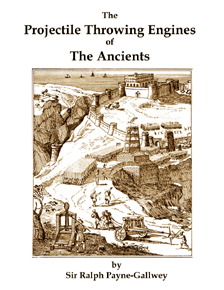
Written by Sir Ralph Payne-Gallwey in 1907,this is the first serious modern work on ancient siege engines and the early history of artillery. In this book, Payne-Gallwey first cites the ancient writings of Greeks and Romans on sieges and the associated artillery. In order to test the validity of the ancient accounts, he produces his own full size working versions of these ancient machines and tests the construction and performance claims of the ancient writers. Fully illustrated, this book gives extensive details about the design, construction, operation and performance of the three types of siege engines: the Catapult (both the Mangonel and Onager), the Ballista and the Trebuchet.
Catapult History - History of Catapults from Archimedes to Cortez
|
|||||||||||||||||||||||||||||||||||||||||||||||||||||||||||||||||||||||||||||||||||||||||||||||||||||||||||||||||||||||||||||||||||||||||||||||||||||||||||||||||||||||