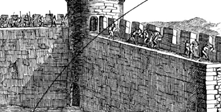
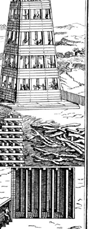
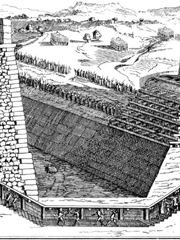
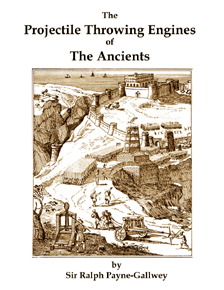
HISTORICAL NOTES upon another by the darts and stones which the engines threw upon them, did not desert the wall. . . . The engines could not be seen at a great distance and so what was thrown by them was hard to be avoided ; for the force with which these engines threw stones and darts made them wound several at a time, and the violence of the stones that were cast by the engines was so great that they carried away the pinnacles of the wall and broke off the corners of the towers ; for no body of men could be so strong as not to be overthrown to the last rank by the largeness of the stones. . . . The noise of the instruments themselves was very terrible, the sound of the darts and stones that were thrown by them was so also ; of the same sort was that noise that dead bodies made when they were dashed against the wall.' (2) Wars of the Jews, Book V., Chapter VI.-- The siege of Jerusalem, A.D. 70. ' The engines that all the legions had ready prepared for them were admirably contrived ; but still more extraordinary ones belonged to the tenth legion : those that threw darts and those that threw stones were more forcible and larger than the rest, by which they not only repelled the excursions of the Jews but drove those away who were upon the walls also. Now the stones that were cast were of the weight of a talent1 and were carried two or more stades.2 'The blow they gave was no way to be sustained, not only by those who stood first in the way but by those who were beyond them for a great space. 'As for the Jews, they at first watched the coming of the stone, for it was of a white color and could therefore not only be perceived by the great noise it made, but could be seen also before it came by its brightness ; accordingly the watchmen that sat upon the towers gave notice when an engine was let go. . . .so those that were in its way stood off and threw themselves down upon the ground. But the Romans contrived how to prevent this by blacking the stone ; they could then aim with success when the stone was not discerned beforehand, as it had been previously.' The accounts given by Josephus are direct and trustworthy evidence, for the reason that this chronicler relates what he personally witnessed during the sieges he describes, in one of which (Jotapata) he acted the part of a brave and resourceful commander. Tacitus in describing a battle fought near Cremona between the armies of Vitellius and Vespasian, A.D. 69, writes : ' The Vitellians at this time changed the position of their battering-engines, which in the beginning were placed in different parts of the field and could only play at random against the woods and hedges that sheltered the enemy. They were now moved to 1 57 3/4 lbs.. (avoirdupois). 2 Two stades would be 404 yards ; the measure of a stade is 606 3/4 English feet. 37 HISTORICAL NOTES The Postumian way, and thence having an open space before them could discharge, their missiles with good effect.' 1 Froissart chronicles that at the siege of Thyn-l'Ev.que,1340, in the Low Countries, 'John, Duke of Normandy had a great abundance of engines carted from Cambrai and Douai Among the others he had six very large ones which he placed before the fortress, and which day and night cast great stones which battered in the tops on the roofs of the towers and of the rooms and halls, so much so that the men who defended the place took refuge in the cellars and vaults.' Camden records that the strength of the engines employed for throwing stones was incredibly great and that with the engines called mangonels2 they used to throw millstones. Camden adds that when King John laid siege to Bedford Castle, there were on the east side of the castle two catapults battering the old tower, as also two upon the south side besides another on the north side which beat two breaches in the walls. The same authority asserts that when Henry III. was besieging Kenilworth Castle, the garrison had engines which cast stones of a extraordinary size, and that near the castle several balls of stones sixteen inches in diameter have been found which are supposed to have been thrown by engines with slings3 in the time of the Barons' war. Holinshed writes that ' when Edward I attacked Stirling Castle, he caused an engine of wood to be set up to batter the castle which shot stones of two or three hundredweight.' . Pere Daniel, in his Histoire de la Milice Francoise, writes : ' The great object of the French engineers was to make siege of sufficient strength to project stones large enough to crush the roofs of houses and break down the walls.' This author continues : 'The French engineers were so successful and cast stones of such enormous size that their missiles even penetrated the vaults and floors of the most solidly built houses.'4 The effects of the ballista on the defenders of a town were in no degree inferior to those of the catapult. The missile of the ballista consisted of a huge metal-tipped wooden bolt which, although of far less weight than the great ball of stone cast by a catapult or the far larger one thrown by a trebuchet, was 1 Tacitus continues : 'The fifteenth legion had an engine of enormous size, which was played off with dreadful execution and discharge massy stones of a weight to crush whole ranks at once. Inevitable ruin must have followed if two soldiers had not signalized themselves by a brave exploit. Covering themselves with shields of the enemy which they found among the slain, they advanced undiscovered to the battering-engine and cut its ropes and springs. In this bold adventure they both perished and with them two names that deserved to be immortal.' 2 Catapults were often called mangons or mangonels, but in course of time the name magonel was applied to any siege engine that projected stones or arrows. In this case the trebuchet is intended, as no catapult could project a millstone. 3 The engines here alluded to by Camden were trebuchets. 4 These engines would also be trebuchets. 38 HISTORICAL NOTES able to penetrate roofs and cause great destruction in ranks of soldiers. Cesar records that when his lieutenant Caius Trebonius was building a moveable tower at the siege of Marseilles, the only method of protecting the workmen from the darts of engines1 was by hanging curtains woven from cable-ropes on the three sides of the tower exposed to the besiegers.2 Procopius relates that during the siege of Rome in 537 by Vitiges King of Italy, he saw a Gothic chieftain in amour suspended to a tree which he had climbed, and to which he had bee nailed by a ballista bolt which had passed through his body and then penetrated into the tree behind him. Again, at the siege of Paris by the Northmen in 885-886, Abbo writes that Ebolus3 discharged from a ballista a bolt which transfixed several of the enemy. With grim humor Ebolus bade their comrades carry the slain to the kitchen, his suggestion being that the men impaled on the shaft of the ballista resembled fowls run through with a spit previous to being roasted. Not only were ponderous balls of stone and heavy bolts projected into a town and against its walls and their defenders, but, with a view to causing a pestilence, it was also the custom to throw in dead horses, and even the bodies of soldiers who had been killed in sorties or assaults. For example, Varillas4 writes that 'at his ineffectual siege of Carolstein in 1422, Coribut caused the bodies of his solders whom the besieged had killed to be thrown into the town in addition to 2,000 cartloads of manure. A great numbers of the defenders fell victims to the fever which resulted from the stench, and the remainder were only saved from death by the skill of a rich apothecary who circulated in Carolstein remedies against the poison which infected the town.' Froissart tells us that at the siege of Auberoche, an emissary who came to treat for terms was seized and shot back into town. This author writes : 'To make it more serious, they took the varlet and hung the letters around his neck and instantly placed him in the sling of an engine and then shot him back again into Auberoche. The varlet arrived dead before the knights who were there and who were much astonished and discomfited when they saw him arrive.' Another historian explains that to shoot a man from the sling of an engine he must first be tied up with the ropes, so as to form a round bundle like a sack of grain. The engine with which such fiendish deeds were achieved was the trebuchet. 2 'For this was the only sort of defense which they had learned, by experience in other places, could not be pierced by darts or engines'. Cesar's Commentaries on the Civil War, Book II., Chapter IX. 3 Abbot of Saint-Germain des Pris and one of the chief defenders of the town. 4 French historian, born 1624, died 1696. 39 The Projectile Throwing Engines of The Ancients Design, Construction and Operation of Ancient Greek, Roman and Medieval Siege Engines and Their Effects In Warfare
Written by Sir Ralph Payne-Gallwey in 1907,this is the first serious modern work on ancient siege engines and the early history of artillery. In this book, Payne-Gallwey first cites the ancient writings of Greeks and Romans on sieges and the associated artillery. In order to test the validity of the ancient accounts, he produces his own full size working versions of these ancient machines and tests the construction and performance claims of the ancient writers. Fully illustrated, this book gives extensive details about the design, construction, operation and performance of the three types of siege engines: the Catapult (both the Mangonel and Onager), the Ballista and the Trebuchet.
Catapult History - History of the French Catapult
|
|||||||||||||||||||||||||||||||||||||||||||||||||||||||||||||||||||||||||||||||||||||||||||||||||||||||||||||||||||||||||||||||||||||||||||||||||||||||||||||||||||||||