|
Oriental Bows - The Thumb
Ring
The range of a flight arrow when shot from a bow by means of a thumb-ring
is always much beyond that of an arrow shot with the three fingers in the
usual manner.
With the thumb-ring the feathers of an arrow can be placed close to
its nock, as the usual space of about 1 1/2 in. need not be left on the
shaft at the butt-end lest the fingers holding the bow-string should crush
the feathers of the arrow - a precaution that is necessary in all European
archery.
There is no doubt that the closer to the nock the feathers of an arrow
can be fixed, the farther and steadier it will travel.
The handle of an English bow, or of any other bow that is loosed with
the fingers, is placed below its centre so that the arrow can be fitted
to the middle of the bow-string, a point which is just above the hand of
the archer as he grasps the bow.
A bow held below its centre can never be pulled really true, the limb
below the handle being shorter than the one above it.
In a Turkish bow the handle is in its exact centre of length, and the
projecting point, or lip, of the thumb-ring engages the bow-string close
to its centre.
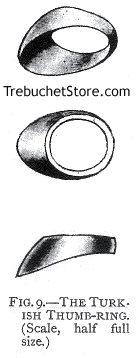
Fig. 9. - The Turkish Thumb-Ring, Scale: Half full
size.
For these reasons the bow is equally strained, each of its limbs doing
its proper share of work in driving the arrow, an advantage that is very
noticeable in flight-shooting, and would probably also be at the target.
In the method of loosing used in modern times the bow-string lies across
the three middle fingers, its outline, where the arrow is nocked on the
string, taking the form of two angles connected by a straight line 2 1/2
to 3 in. in length.
With the thumb-ring the bow-string is drawn back to one sharp angle
close to the apex of which the nock of the arrow is fitted, so that every
part of the string is utilised in driving the arrow. (Fig. 12, p. 14.)
The ease with which a strong bow can be drawn with the thumb-ring, and
the entire absence of any unpleasant strain on the thumb, is remarkable.
This proves how effective the Oriental style of loosing a bow-string was,
compared with the one practised by European archers.
The ring was usually of ivory, its edges being round and smooth where
they came in contact with the skin of the thumb.
A covering of soft leather was sometimes glued all over the sloping
outer surface of the projecting lip of the ring.
The leather assisted the archer to hold the ring firmly with his forefinger,
so that it could not slip under the strain of pulling back the bow-string.
The |