|
The Catapult
A.A. The skein of twisted cord.
B.B. The large winding wheels. The skein is stretched between these
wheels, its ends passing through the sides of the frame, and then through
the wheels and over there crossbars. (Fig. 6, p. 17.)
By turning the long spanner (fig 1, p. 10) the squared ends of the spindles
DD, the pinion wheels CC rotate the large wheels BB and cause the latter
to twist the skein. AA, between the halves of which the arm EE is placed.
FF. The wooden roller which winds down the arm EE. (Fig. 1, p.
10.)
The roller is revolved by four men (two on each side of the engine)
who fit long spanners on the squared ends of the iron spindle GG.
This spindle passes through the center of the roller and through the
sides of the frame.
The small cogged wheels, with their checks, which are fitted to the
ends of the spindle GG, prevent the roller from reversing as the arm is
being wound down. (Fig 1, p. 10.)
HH. The hollows in the sides of the frame which receive the lower tenons
of the two uprights. Between the tops of these uprights the cross-beam
is fixed against which the arm of the catapult strikes when it is released.
(Fig 1, p. 10.)
KK. The hollows for the lower tenons of the two sloping supports which
prevent the uprights, and the cross-beam between them, from giving way
when the arm recoils. (Fig. 1. p. 10.)
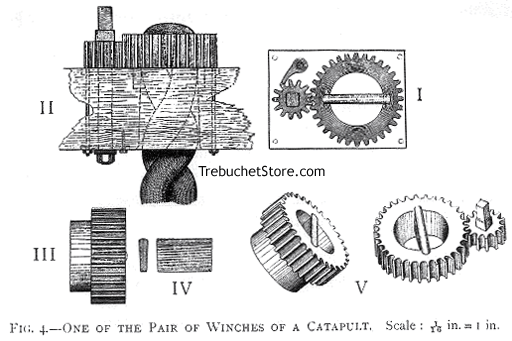
Fig. 4. - One of the Pair of Winches of a Catapult.
Scale: 1/16 in = 1 in.
I. Surface view of one of the winches and the thick iron plate in which
the socket of the large winding wheel of the winch revolves |