The
Crossbow > Chapter 30 >
Crossbow with Steel Bow > Bent by a Cranequin
> .p.131
Chapter XXX
The Sixteenth Century Sporting Crossbow, with Thick
Steel Bow which was Bent by a Cranequin
ARBALESTE A CRIC - ARBALESTE A CRANEQUIN - RATCHET CROSSBOW -
RACK AND PINION CROSSBOW
In the last quarter of the fifteenth century the crossbow with its ropes
and windlass, and its stirrup and necessarily long and heavy stock (to
suit the action of the windlass), fell into disfavour with hunters of deer
and other animals. The reason of this was the gradual perfecting of an
instrument for stretching the string of a crossbow which enabled the crossbowman-
to dispense with the cumbersome metal foot-stirrup, and to have a much
shorter and lighter stock to his weapon than had hitherto been possible.
This apparatus was the French ' cranequin ' or ratchet-winder. Not only
was the cranequin simpler in use and more portable than the windlass, but
it was also nearly as powerful, and, as it had no cords to fall out of
repair, was practically indestructible.1
The cranequin was, however, considerably slower to work than a windlass,
and could not, for instance, wind up the bow-string of a military crossbow
with the rapidity necessary in open warfare. Its costly construction was
also against its adoption by soldiery.
Slow to manipulate and expensive to make in comparison with the windlass,
I doubt if the cranequin crossbow was ever popular in armies, though it
is quite likely that it was employed by picked marksmen from behind the
loop-holes and battlements of a besieged fortress. It is stated by various
authors on military subjects, that in the fifteenth century crossbowmen
were sometimes known as ' crenequiniers,' from their practice of shooting
at the besiegers of a castle or town through the crenelles (loop-holes)
in its walls.2
1 The mechanism of the cranequin was precisely
the same as that of the old-fashioned lifting jack to be seen in timber
yards.
2 Crenequin or crennequin is a way of spelling
this word only to be found in modern works on armour and weapons. Cranequin
is the old French spelling, and for this reason I consider there is no
foundation for the surmise that the word ' cranequin' is in any way derived
from "crenelle." In manuscripts of the fifteenth and sixteenth centuries,
cranequin is sometimes spelt crannequin, carnequin, carnequyn and carnequing.
Littre', in his Dictionnaire de la Langue Francaise, states that
' cranequin is derived from the Low German, " Kraeneke, a crane," owing
to its shape.' The crossbow was itself often called a " cranequin," and
the crossbowman a '"cranequinier" or " crannequinier."
|
Save up to 50% with Multi-Plan Deals
|
2 Plans $19.95 FREE Shipping
- Save Over 30%
U.S. Orders Only |
|
Get a Book of Catapult and Trebuchet Plans
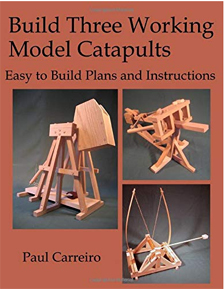
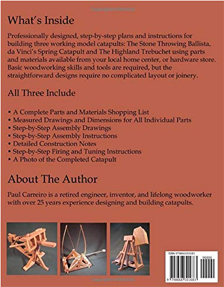
Book of Catapult Plans
On Amazon.com
"Build Three Working Model Catapults, Easy to Build Plans
and Instructions"
|
 Build Three Working Model
Catapults, Easy to Build Plans and Instructions is ideal for anyone
looking to build authentic, working model catapults.
Build Three Working Model
Catapults, Easy to Build Plans and Instructions is ideal for anyone
looking to build authentic, working model catapults.
This book contains professionally designed, step-by-step plans and instructions
for building three working model catapults:
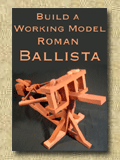
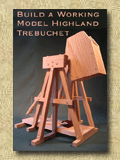
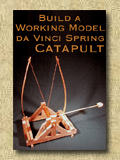
The Stone Throwing Ballista, da Vinci's Spring Catapult and The Highland
Trebuchet using parts and materials available from your local home center,
or hardware store.
The straightforward designs require no complicated layout or joinery
and include:
-
A Complete Parts and Materials Shopping List
-
Measured Drawings and Dimensions for All Individual Parts
-
Step-by-Step Assembly Drawings
-
Step-by-Step Assembly Instructions
-
Detailed Construction Notes
-
Step-by-Step Firing and Tuning Instructions
-
A Photo of the Completed Catapult
|
| Working Model Trebuchet Kit |
 |
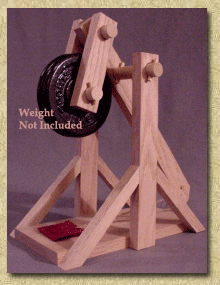 Trebuchet
Kit
Trebuchet
Kit
TK1
|
$75.00
FREE Shipping
U.S. Orders Only |

|
|
|
The trebuchet kit includes fully precut and drilled
frame parts, pins and axles, sling cord and sewn pouch, projectiles and
fully illustrated assembly and firing instructions.
Unlike the flimsy, snap together plywood trebuchet
kits, our all hardwood trebuchet kit does not require additional cutting,
trimming or shaping.
Requires only white carpenter's glue and a few
bar clamps (not included) to assemble.
Read
More >> |
Build a Trebuchet From Plans
 |
|
-
Materials Shopping List
-
Complete Parts List
-
Measured Drawings for All Parts
-
Step-By-Step Assembly Drawings
-
Construction Details and Notes
-
How a Trebuchet Works
-
Illustrated Firing Instructions
-
Illustrated Tuning Instructions
-
Picture of the Completed Trebuchet
|
| Fully Assembled Working Models |
|
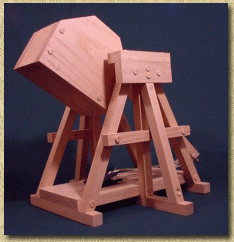
daVinci
Trebuchet
T4 |
$299.00
FREE Shipping
U.S. Orders Only
|
|
| |
|
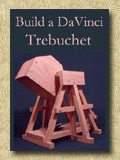
Inspired by the great war machines and siege catapults of Leonardo da Vinci
, this all Red Oak
hardwood trebuchet features
an open counterweight cabinet for range and trajectory adjustment.
Individually crafted from cabinet-grade red oak, the da Vinci Trebuchet
stands 14 inches tall in the cocked position, 24 inches tall in the fired
position and will hurl a projectile up to 60 feet. Includes six projectiles
and fully illustrated instructions.
Read
More >> |
|