|
|
The
Crossbow > Chapter 3
> General Dimensions of Crossbows
> p.15
The Dimensions of Crossbows
sporting friends who were interested in the attempt, and who declared
that the feat was impossible.
The distance achieved by the bolts, according to Ordnance Survey, was
between 440 and 450 yards.
It is most unlikely that a missile of any kind has previously been projected
without the aid of gunpowder, from one shore to the other, across this
arm of the sea.
The large Military Crossbow with a thick steel
bow, which was carried by the crossbowman in battle, as at Agincourt for
instance, weighed from 15 lbs. to 16 lbs. without its windlass.
Its steel bow was from 2 ft. 7 in. to 2 ft. 8 in. long, and at its centre
1 3/4 in. to 2 in. wide, and 5/8 in. to 3/4 in. thick.
The Sporting Crossbow for killing deer by means
of an ordinary bolt, weighed from 12 Lbs. to 14 Lbs. without its windlass;
or, by reason of its then smaller stock, from 10 Lbs. to 12 Lbs. if a cranequin,
instead of a windlass, was employed to wind up the bowstring. Its steel
bow was from 2 ft. 5 in. to 2 ft. 6 in. long, and at its centre 1/ 1/2
in. to 1 3/4 in. wide, and 1/2 in. to 5/8 in. thick.1
The Smaller Sporting Crossbow, such as was
used in Spain for killing deer with a poisoned bolt, and small animals
and large birds with an ordinary bolt, weighed from 8 Lbs. to 9 Lbs. without
its cranequin. Its steel bow was from 2 ft. 4 in. to 2 ft. 5 in. long,
and at its centre 1 3/8 in. to 1 1/2 in. wide, and 3/8 in. to 1/2 in. thick.
NOTE. - The details concerning dimensions, weights and
ranges given in Chapters III. and IV. are derived from a careful personal
inspection and trial of a large number of late fifteenth, and early sixteenth-century
crossbows. The ranges were in all cases measured by surveyor's chain and
not by footpace.
This weapon is described in Chapters XIX.-XXVIII
The Crossbow
> Chapter 3 > General
Dimensions of Crossbows > p.15
|
Save up to 50% with Multi-Plan Deals
|
2 Plans $19.95 FREE Shipping
- Save Over 30%
U.S. Orders Only |
|
Get a Book of Catapult and Trebuchet Plans
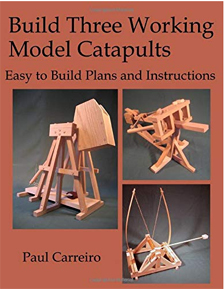
Book of Catapult Plans
On Amazon.com
"Build Three Working Model Catapults, Easy to Build Plans
and Instructions"
|
 Build Three Working Model
Catapults, Easy to Build Plans and Instructions is ideal for anyone
looking to build authentic, working model catapults.
Build Three Working Model
Catapults, Easy to Build Plans and Instructions is ideal for anyone
looking to build authentic, working model catapults.
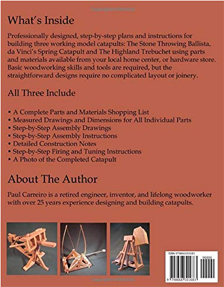
This book contains professionally designed, step-by-step plans and instructions
for building three working model catapults:
The Stone Throwing Ballista, da Vinci's Spring Catapult and The Highland
Trebuchet using parts and materials available from your local home center,
or hardware store.
The straightforward designs require no complicated layout or joinery
and include:
-
A Complete Parts and Materials Shopping List
-
Measured Drawings and Dimensions for All Individual Parts
-
Step-by-Step Assembly Drawings
-
Step-by-Step Assembly Instructions
-
Detailed Construction Notes
-
Step-by-Step Firing and Tuning Instructions
-
A Photo of the Completed Catapult
|
| Working Model Trebuchet Kit |
 |
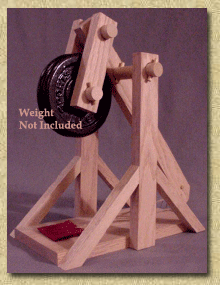 Trebuchet
Kit
Trebuchet
Kit
TK1
|
$75.00
FREE Shipping
U.S. Orders Only |

|
|
|
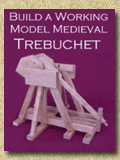
The trebuchet kit includes fully precut and drilled
frame parts, pins and axles, sling cord and sewn pouch, projectiles and
fully illustrated assembly and firing instructions.
Unlike the flimsy, snap together plywood trebuchet
kits, our all hardwood trebuchet kit does not require additional cutting,
trimming or shaping.
Requires only white carpenter's glue and a few
bar clamps (not included) to assemble.
Read
More >> |
Build a Trebuchet From Plans
 |
|
-
Materials Shopping List
-
Complete Parts List
-
Measured Drawings for All Parts
-
Step-By-Step Assembly Drawings
-
Construction Details and Notes
-
How a Trebuchet Works
-
Illustrated Firing Instructions
-
Illustrated Tuning Instructions
-
Picture of the Completed Trebuchet
|
| Fully Assembled Working Models |
|
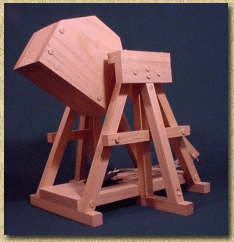
daVinci
Trebuchet
T4 |
$299.00
FREE Shipping
U.S. Orders Only
|
|
| |
|
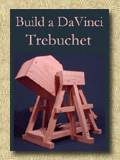
Inspired by the great war machines and siege catapults of Leonardo da Vinci
, this all Red Oak
hardwood trebuchet features
an open counterweight cabinet for range and trajectory adjustment.
Individually crafted from cabinet-grade red oak, the da Vinci Trebuchet
stands 14 inches tall in the cocked position, 24 inches tall in the fired
position and will hurl a projectile up to 60 feet. Includes six projectiles
and fully illustrated instructions.
Read
More >> |
|