|
Ancient Siege Engines in Warfare
His recommendation of the Roman siege engine in preference to the cannon
of his time reads very curiously, especially when published at so late
a date as 1727.
His reference to the crossbow as a superior arm to the gun in warfare
is also interesting, however primitive the latter weapon may have then
been.
de Folard writes : ' I am convinced that if it were possible to lay
aside the prejudice of custom, catapults and balistas would soon reduce
to silence our mortars and swivel-guns ; for who can doubt that catapults
were the more useful for throwing stones and bombs ? How much would they
not save in sieges ?

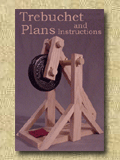
Fig. 190. - A Trebuchet on Wheels. The Detachable
Iron Weights which Hook On to the Butt of the Arm May be Seen Inside the
Framework of the Engine.
Criticism. The arm has no sling attached to it and
resembles the arm of a catapult. An engine of this construction would not
be able to cast a stone 100 yards, if, indeed 50 yards.
What paraphernalia, what an array of material, equipages, horses, men
and workmen for the service and transport of mortars !
' It is apparent that a dozen mules sufficed for the carriage of the
ropes, winches, arms, cushions and all the utensils necessary for several
large catapults. All else required for their construction can be found
wherever there are trees of a certain size, no matter what the nature of
the wood.
'All kinds of stones are suitable for catapults, whereas balls only
can be used for our swivel-guns. A mortar of the greatest capacity can
scarcely throw a weight of 60 Lbs., while the catapult can throw 100 Lbs. |