|
|
The
Crossbow > Chapter 5
> Range of the Medieval Crossbow
> p.28
The Crossbow
So much for the triumph of the Infidels and the humiliation of Christendom.
Yours aff.
W. Frankland
To Sir Thos. Frandland Bt., M.P.
Thirkleby Park'.
I found the following in a manuscript notebook of 1798 describing feats
and incidents of archery, collected by the recipient of the above letter.
'Records of Turkish archery procured
in 1797 from Constantinople by Sir Robert Ainslie, at the request of Sir
Joseph Banks, and translated by Sir Robert Ainslie's interpreter.'
' The Turks still have detachments of archers in their armies, merely
not to deviate from ancient custom, for, in Turkey, archery is now merely
regarded as an amusing exercise that is to this day practised by all ranks
of the people.
The Ottoman emperors, with their court, often enjoy the diversion of
archery in public, and there is an extensive piece of ground allotted to
that purpose.
This place is upon an eminence in the suburbs of the city of Constantinople,
and commands an extensive view of the town and harbour. It is called Ok
Meydan, or the Place of the Arrow. The ground mentioned is covered with
marble pillars erected in honour of those archers who have succeeded in
shooting arrows to any remarkable distance. Each pillar is inscribed with
the name of the person whose dexterity it records, together with some complimentary
verses to him, and the exact range which he attained with his flight arrow.
The Ottoman emperors, from ancient times, have been always supposed
to live by their manual labour, and in consequence of this supposition
they have each learnt some art or profession, most of them having preferred
the art of making bows and arrows.
The present emperor was bound apprentice to the trade of archery, and
at the time he was received as a master in this trade, he gave on different
occasions very splendid public entertainments at the Ok Meydan, where the
State tents were pitched for him and his court.
The Tartar bows are preferable to those manufactured in Turkey, as the
former are the larger and stronger, though there is now an extensive factory
for implements of archery in Constantinople, called Ok Zilar, or the place
of the Arrow-makers.
The Turkish bow is formed of a
very strong elastic wood. One side of the bow is covered with a composition
made chiefly of buffalo horn melted down ; this is smoothed with a file
to a proper shape, and forms the concave side of the bow when it is bent.
The Crossbow
> Chapter 5 > Range
of the Medieval Crossbow > p.28
|
Save up to 50% with Multi-Plan Deals
|
2 Plans $19.95 FREE Shipping
- Save Over 30%
U.S. Orders Only |
|
Get a Book of Catapult and Trebuchet Plans
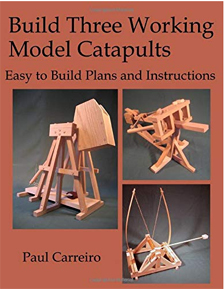
Book of Catapult Plans
On Amazon.com
"Build Three Working Model Catapults, Easy to Build Plans
and Instructions"
|
 Build Three Working Model
Catapults, Easy to Build Plans and Instructions is ideal for anyone
looking to build authentic, working model catapults.
Build Three Working Model
Catapults, Easy to Build Plans and Instructions is ideal for anyone
looking to build authentic, working model catapults.
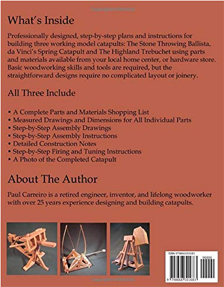
This book contains professionally designed, step-by-step plans and instructions
for building three working model catapults:
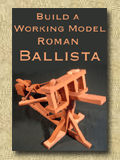
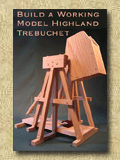
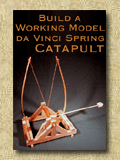
The Stone Throwing Ballista, da Vinci's Spring Catapult and The Highland
Trebuchet using parts and materials available from your local home center,
or hardware store.
The straightforward designs require no complicated layout or joinery
and include:
-
A Complete Parts and Materials Shopping List
-
Measured Drawings and Dimensions for All Individual Parts
-
Step-by-Step Assembly Drawings
-
Step-by-Step Assembly Instructions
-
Detailed Construction Notes
-
Step-by-Step Firing and Tuning Instructions
-
A Photo of the Completed Catapult
|
| Working Model Trebuchet Kit |
 |
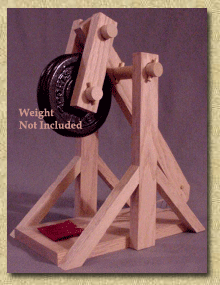 Trebuchet
Kit
Trebuchet
Kit
TK1
|
$75.00
FREE Shipping
U.S. Orders Only |

|
|
|
The trebuchet kit includes fully precut and drilled
frame parts, pins and axles, sling cord and sewn pouch, projectiles and
fully illustrated assembly and firing instructions.
Unlike the flimsy, snap together plywood trebuchet
kits, our all hardwood trebuchet kit does not require additional cutting,
trimming or shaping.
Requires only white carpenter's glue and a few
bar clamps (not included) to assemble.
Read
More >> |
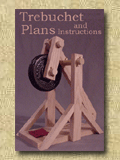
Build a Trebuchet From Plans
 |
|
-
Materials Shopping List
-
Complete Parts List
-
Measured Drawings for All Parts
-
Step-By-Step Assembly Drawings
-
Construction Details and Notes
-
How a Trebuchet Works
-
Illustrated Firing Instructions
-
Illustrated Tuning Instructions
-
Picture of the Completed Trebuchet
|
| Fully Assembled Working Models |
|
daVinci
Trebuchet
T4 |
$299.00
FREE Shipping
U.S. Orders Only
|
|
| |
|
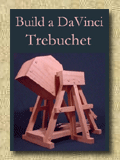
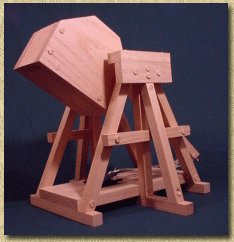
Inspired by the great war machines and siege catapults of Leonardo da Vinci
, this all Red Oak
hardwood trebuchet features
an open counterweight cabinet for range and trajectory adjustment.
Individually crafted from cabinet-grade red oak, the da Vinci Trebuchet
stands 14 inches tall in the cocked position, 24 inches tall in the fired
position and will hurl a projectile up to 60 feet. Includes six projectiles
and fully illustrated instructions.
Read
More >> |
|