|
The Catapult
from a small mortar, it would be a more or less effective one in the
days, for example, of the Crusades ; in days when the besiegers camped
within a quarter of a mile of the town they were attacking and even conversed
with the defenders on its walls.
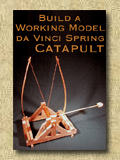
The great Roman catapult was about twice the size in length and breadth
of the one I have given details of.
This immense and powerful machine had an arm of from 10 to 12 ft. long.
An engine of these dimensions - according to the size of its skein -
pitched a stone of from 40 to 60 lbs. to a distance of from 350 to 400
yards, the most powerful weapon of the kind being probably able to attain
a range of nearly 450 yards.
The velocity of the stone propelled by a catapult was very low as compared
with that of a ball from a cannon. It was the ponderous nature of the projectile
and not its velocity that did the execution.
A stone of 50 lbs., falling from a short range on battlements and the
tops of towers, or among crowded troops and lightly built houses, would
be as destructive as a ball of half the weight fired from a cannon at a
much longer distance than was possible with a catapult.
The damage to buildings and the slaughter of people must have been terrible,
when we consider that 150 to 200 great catapults were often employed at
the same time for pounding a city and its defenders, and further, that
these engines could be used as freely on the darkest night as by daylight.
Not only were heavy stones thrown among the besieged, their fortifications
and their houses, but flaming projectiles were also used which set fire
to everything combustible upon which they fell.
Each side of a large catapult was made of two huge logs of wood. The
logs were squared and then placed one above the other and bolted together.
Winches suitable for twisting a skein of cord such as a 10 to 12 ft. arm
required - would necessitate timber of so great a size, that the ancients
found it easier to construct the sides of their largest catapults of two
longitudinal pieces.
The skein of cord for a catapult with an arm 12 ft. in length, was much
larger in proportion to the size of the engine than was the case with a
weapon that had a framework of half the dimensions.1
1 The catapult with an arm 10 to 12 ft. in
length, also cast a stone three times as heavy as that thrown by a weapon
half its size. |