|
Chapter LVIII
The Trebuchet
This engine was of much more recent invention than either the catapult
or the balista of the Greeks and Romans. It is said to have been introduced
into siege operations by the French in the twelfth century. On the other
hand, the catapult and the balista were in use before the Christian Era.
Egidio Colonna gives a fairly accurate description of the trebuchet, and
writes of it about 1280 as though it were the most effective siege weapon
of his time.
The projectile force of this weapon was obtained from the terrestrial
gravitation of a heavy weight, and not from twisted cordage as in the catapult
and balista.
From about the middle of the thirteenth century, the trebuchet in great
measure superseded the catapult. This preference for the trebuchet was
due to the fact that it was able to cast stones of 300 lbs. and more in
weight, or five or six times as heavy as those which the largest catapults
could project.
The stones of 50 to 60 Lbs. thrown by siege catapults would no doubt
destroy towers and battlements, as the result of the constant and concentrated
bombardment of many engines. One huge stone of 300 Lbs., as slung from
a trebuchet, would however shake the strongest defensive masonry and easily
break through the upper parts of the walls of a fortress.
The trebuchet was essentially an engine for destroying the defences
of a fortification, so that it might be entered by means of scaling ladders
or in other ways.
From experiments with models of good size and from other sources, I
find that the largest trebuchets - those with arms of about 50 ft. in length
and counterpoises of about 20,000 Lbs.- were capable of slinging a stone
300 Lbs. in weight to a distance of 300 yards, a range of 350 yards being
in my opinion more than these engines were able to attain.1
1 Egidio Colonna tells us that the trebuchet
was sometimes made without a counterpoise, and that in such a case the
arm of the engine was worked by a number of men pulling together instead
of by a heavy weight. I cannot believe this, as however many men pulled
at the arm of a trebuchet they could not apply nearly the force that would
be conveyed by the terrestrial gravitation of a heavy weight.
|
|
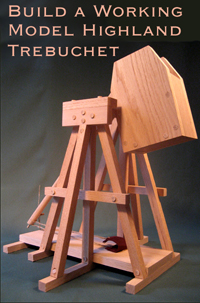 Trebuchet Plans
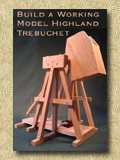
Build a classic hinged counterweight trebuchet with TrebuchetStore.com
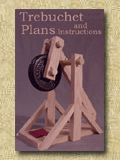
Trebuchet Plans and Instructions. Once complete, this magnificent Highland
Trebuchet stands over 36 inches tall and will throw a scale projectile
up to 80 feet.
Professional Design
Professionally engineered with an open counterweight cabinet, the Highland
Trebuchet allows you to vary the weight for range and trajectory adjustment.
Fire with an empty counterweight for indoor use, or add weight for increased
power and range.
Great Project
The Highland Trebuchet is perfect for demonstrating medieval warfare
and technology and the physics of leverage, ballistics and projectile motion.
Trebuchets and catapults make great science and history projects.
Easy to Build
All TrebuchetStore.com trebuchet
plans use common, inexpensive and easy to find building materials, available
at your local hardware store or home center. Basic woodworking skills and
tools are required, but the straightforward design requires no complicated
layout or joinery.
TrebuchetStore.com trebuchet
and catapult plans come complete with:
-
Parts Shopping List
-
Measured Drawings for all parts
-
Assembly Drawings
-
Step by step Assembly Instructions
-
Step by step Firing and Tuning Instructions
-
How a Trebuchet Works
All the information you need to complete your project quickly and easily.
Want to know how to build a trebuchet ? TrebuchetStore.com
Plans and Instructions take the mystery out of trebuchet design and construction.
More Trebuchet Plans
 |
 |
 |
|
|
Medieval Trebuchet
|
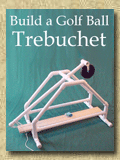
Golf Ball Trebuchet
|
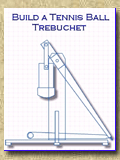
Tennis Ball Trebuchet |
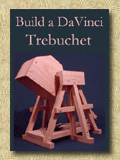
daVinci Trebuchet
|
|
|