|
|
The
Crossbow > Chapter 9
> History of the Crossbow
> p.44
The Crossbow
museum at Puy, in France, present,
1 ' Erant tragularii, qui ad manuballistas
vel arcuballistas dirigebant sagittas,' Book II., Chapter 15 - with them
were the javelin men, who from their bows in hand or crossbows directed
their arrows.
writes Victor Gay,1 all the characteristics of the primitive
crossbow carried by hand.
From the fifth to the tenth century, all evidence, historical or pictorial,
is wanting as to whether the crossbow was in common use or not.
In the tenth century, the crossbow was, however, a popular arm, as the
two following extracts quoted by Victor Gay prove. These are taken from
the printed reproduction of the tenth century MS. of the monk Richer's
' Historia.'
1. King Lewis, with an army from Belgium, enters the territory of the
Duke, in 947. First he attacks the city of Senlis ... on both sides very
many are wounded. But the Belgians, because they were attacked vigorously
by the crossbowmen of the city, could not resist ... so by order of the
king they draw off from that city, not only by reason of the crossbowmen,
but also because of the strength of the towers.
2. And here Lothair, with 10,000 men, made for Verdun, 985. The bowmen
were set against the foe, and the arrows discharged, and the missiles from
the crossbows, were careering about in the air so thickly, that they seemed
to be coming down from heaven and rising out of the earth.
In the picture of the martyrdom of St. Sebastian, which took place in
288, and was a favourite subject for Italian masters in the fifteenth and
sixteenth centuries - such as Mantegna, Veronese, Domenico - the Saint
is often shown as being pierced by his assailants with bolts from crossbows.
The crossbows are in some cases minutely depicted, as well as the manner
of stretching their strings, especially in the large picture by Pollajuolo2
dated 1475, now in the National Gallery in London, fig. 31, p. 74.
It is curious that the crossbow is not to be found in any illustrated
manuscript of the time, as having been used at the landing of the Normans
in England in 1066, at the battle of Hastings, or during the subsequent
conquest of England, 1066-1071. The Bayeux tapestry3 with its
hundreds of knights and soldiers, with swords, spears, bows and arrows,
is contemporary with, and was specially designed to commemorate the Norman
invasion of Britain, and the attendant battles, yet it does not contain
one crossbow.
We know, however, that crossbows were brought to England by the Normans
in 1066, for they are distinctly alluded to in a contemporary
1 Victor Gay, Archazological Glossary of
the Middle Ages and the Renaissance. Paris, 1887.
2 Antonio Pollajuolo, Italian painter, born
1429, died 1498.
3 This piece of work is 230 feet long by 20
inches wide. It contains 623 persons, besides 762 horses, dogs and other
animals, 27 buildings, and 41 ships and boats.
The Crossbow
> Chapter 9 >
History of the Crossbow >
p.44
|
Save up to 50% with Multi-Plan Deals
|
2 Plans $19.95 FREE Shipping
- Save Over 30%
U.S. Orders Only |
|
Get a Book of Catapult and Trebuchet Plans
Book of Catapult Plans
On Amazon.com
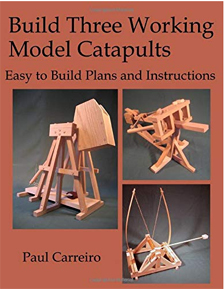
"Build Three Working Model Catapults, Easy to Build Plans
and Instructions"
|
 Build Three Working Model
Catapults, Easy to Build Plans and Instructions is ideal for anyone
looking to build authentic, working model catapults.
Build Three Working Model
Catapults, Easy to Build Plans and Instructions is ideal for anyone
looking to build authentic, working model catapults.
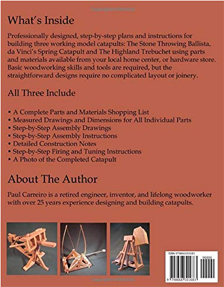
This book contains professionally designed, step-by-step plans and instructions
for building three working model catapults:
The Stone Throwing Ballista, da Vinci's Spring Catapult and The Highland
Trebuchet using parts and materials available from your local home center,
or hardware store.
The straightforward designs require no complicated layout or joinery
and include:
-
A Complete Parts and Materials Shopping List
-
Measured Drawings and Dimensions for All Individual Parts
-
Step-by-Step Assembly Drawings
-
Step-by-Step Assembly Instructions
-
Detailed Construction Notes
-
Step-by-Step Firing and Tuning Instructions
-
A Photo of the Completed Catapult
|
| Working Model Trebuchet Kit |
 |
 Trebuchet
Kit
Trebuchet
Kit
TK1
|
$75.00
FREE Shipping
U.S. Orders Only |

|
|
|
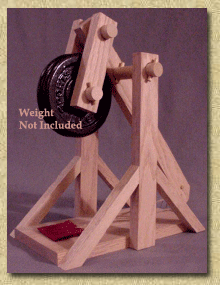
The trebuchet kit includes fully precut and drilled
frame parts, pins and axles, sling cord and sewn pouch, projectiles and
fully illustrated assembly and firing instructions.
Unlike the flimsy, snap together plywood trebuchet
kits, our all hardwood trebuchet kit does not require additional cutting,
trimming or shaping.
Requires only white carpenter's glue and a few
bar clamps (not included) to assemble.
Read
More >> |
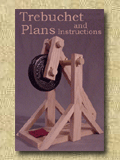
Build a Trebuchet From Plans
 |
|
-
Materials Shopping List
-
Complete Parts List
-
Measured Drawings for All Parts
-
Step-By-Step Assembly Drawings
-
Construction Details and Notes
-
How a Trebuchet Works
-
Illustrated Firing Instructions
-
Illustrated Tuning Instructions
-
Picture of the Completed Trebuchet
|
| Fully Assembled Working Models |
|
daVinci
Trebuchet
T4 |
$299.00
FREE Shipping
U.S. Orders Only
|
|
| |
|
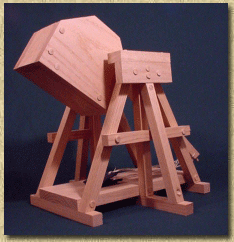
Inspired by the great war machines and siege catapults of Leonardo da Vinci
, this all Red Oak
hardwood trebuchet features
an open counterweight cabinet for range and trajectory adjustment.
Individually crafted from cabinet-grade red oak, the da Vinci Trebuchet
stands 14 inches tall in the cocked position, 24 inches tall in the fired
position and will hurl a projectile up to 60 feet. Includes six projectiles
and fully illustrated instructions.
Read
More >> |
|