|
The Crossbow with a Composite
Bow
In manuscripts of the thirteenth, fourteenth and first half of the fifteenth
century, I find many allusions to soldiers armed with horn crossbows.
Doubtless on the coasts of Scandinavia and North Germany, the chief
home of these composite crossbows after the time of the Crusades, whalebone
was easily obtainable, whilst in other parts of the Continent, the pieces
which formed the heart of the bow, were made from the straightened horn
of an animal.
This ancient form of crossbow with a composite bow, survived in an improved
form in Scandinavia and in the north of Europe, as a weapon of sport and
war, till about 1460, or for nearly a hundred years after the far superior
crossbow with a thick steel bow and a windlass had been in use in France,
Spain and Italy. Some of these later weapons were made so strong in the
fifteenth century, that after the invention of the powerful cranequin for
bending steel bows, this apparatus was also employed for bending the composite
bow.
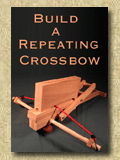
Several of the larger crossbows with composite bows, to be seen in the
museums of North Germany, have the steel cross-pin projecting on each side
of the stock, some six or seven inches behind the catch for the bowstring,
which shows beyond question -that a ' cranequin ' was applied to bend their
bows, fig. 26, p. 63. |