|
Oriental Bows - Stringing
the slightest lateral twist as they are being bent, the horn parts are
certain to splinter, and the bow is then useless and damaged beyond repair.1
The difficulty of reversing and stringing a very stiff bow with such
a reflex curve that its ends nearly meet before it is bent may be imagined.
De Busbecq tells us that some of the Turkish bows were so strong that
if a coin was placed under the bow-string at one end of the bow, as it
was being strung, no one but a trained archer could bend the bow sufficiently
to set free the coin so that it fell to the ground.
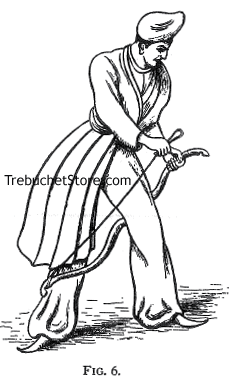
Fig. 6 shows an Oriental reflex bow being gradually reversed preparatory
to fitting on its bow-string.
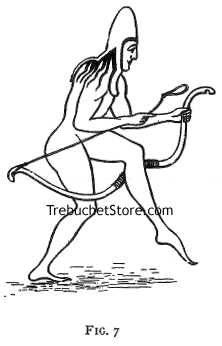
Fig. 7 shows a similar bow when reversed sufficiently to fit its bow-string.
Though this illustration is from an ancient Greek vase, it will be noticed
that in it the power of the leg and arm is applied in precisely the same
way as in the more modern example given.
1 The only safe method for a modern archer
to adopt in order-to string a powerful reflex bow is to use strong upright
pegs, the size of tent pegs, inserted in smooth ground or in holes in a
board, the bow resting during the process flat along the ground or board.
Insert one peg against the inner face of the handle of the bow and then
pull the ends of the bow back by degrees, placing a peg behind each of
its ends as you do so to retain them in their acquired positions. The outer
pegs can be shifted towards you as the bow is gradually bent, first at
its one end and then at its other one. Finally, when the bow is fully bent
the bow-string can be fitted across it from nock to nock and the pegs removed.
To unstring the bow, grasp its extremities and, with the palms of the hands
uppermost, bend it slightly across the knee, at the same time shifting
with the thumb one of the loops of the bow-string out of its nock. |