|
The Horn Groove
The thin horn groove which the Turk wore on the thumb of his left hand
when flight shooting is shown in fig. 8.
This ingenious contrivance enabled the archer to draw the point of his
arrow from 2 to 3 in. within the inner surface of his bent bow. He was
thus able to shoot a short and light arrow that would fly much farther
than the considerably longer and heavier one he would have had to use if
he had shot in the ordinary manner without the grooved horn.
The groove in the horn guides the arrow in safety past the side of the
bow, when the bow string is released by the archer.
The Turk, in fact, shot a short and light arrow from a very powerful
bow, which he bent to the same extent as if he used an arrow 3 in. longer,
with its proportionately increased size, weight and frictional surface
to retard its flight.
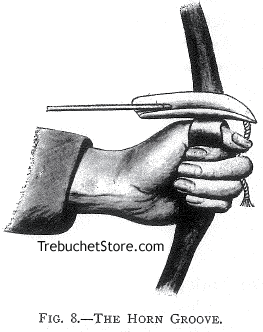
Fig. 8. - The Horn Groove.
The bow is shown fully bent and ready for release,
the point of the arrow being drawn back for a couple of inches inside the
bow.
In the former case it will easily be understood that a much longer range
could be achieved than in the latter.
Of this increase in length of flight conferred by the use of the grooved
horn, the following experiment is conclusive evidence.
I lately shot from a Turkish bow twelve arrows, each arrow being three-quarters
of an ounce in weight and 28 1/2 in. in length.
These twelve arrows were individually drawn to the head and the distance
they reached averaged 275 yards.
I then reduced the same arrows to a length of 25 1/2 in. each, and to
a weight of half an ounce each.
They were now shot from the same bow, over the same range and under
the same conditions of weather; but there point were drawn 2 1/2 in. within
the bow along a grooved horn. The distance they then traveled averaged
360 yards. |