|
The Turkish Bow - Its
Construction
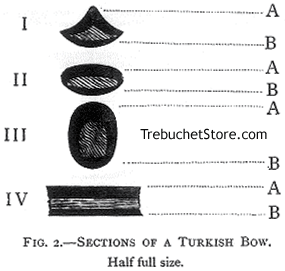
Fig. 2. - Sections of the Turkish Bow.
Half full size.
I. Section of bow at 6 in. from one of its ends.
II. Section of bow at half-way between the centre of its handle and
one of its ends.
III. Section of bow at the centre of its handle, which is here thickly
covered with sinew.
IV. Longitudinal section of bow at half-way between the centre of its
handle and one of its ends.
Light shading, AAAA. The compressed sinew forming the back of
the bow when it is strung.
Dark shading, BBBB. The horn forming the inner surface of the
bow when it is strung.
Lined centres. The thin lath of wood to which the horn and sinew
parts of the bow are moulded and fixed.
The thin wooden lath, in places only 1/8 in. thick, bestowed no strength
on the bow, as it was merely its heart or core to which the two curved
strips of horn and the long band of sinew were glued. (Fig. 3, p. 6.)
As it would have been very difficult and tedious to shape so fragile
a lath in one length to suit the outline of the finished bow, this lath
was always made in three pieces, which were fitted together at their joints
and then secured with glue. (Fig. 3.)
The middle piece formed the core of the handle of the bow and the other
pieces the core of its limbs. (Fig. 3.)
The extremities of the two outer pieces of the wooden core were enlarged
to form the strong projecting points of the bow in which the nocks for
the bow-string were cut. (CC fig. 3.) |