|
The Turkish Bow - Construction
and Dimensions
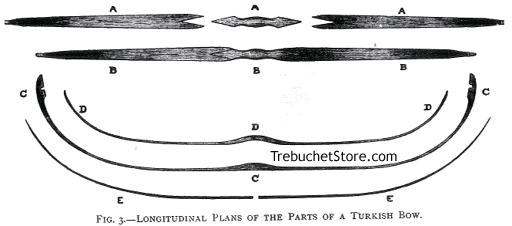
Fig. 3. - Longitudinal Plans of the Parts of the Turkish
Bow.
AAA. The three pieces of thin wood that formed the core of the bow.
Surface view. (The two outer lengths of the core were steamed into a curve
as shown in CCC.)
BBB. The pieces glued together. Surface view.
CCC. The pieces glued together. Side view.
DDD. The strip of sinew that was glued to the core, and which formed
the back or outer surface of the bow when it was reversed and strung.
EE. The two strips of naturally curved horn that were glued to the core,
and which formed the belly or inner surface of the bow when it was reversed
and strung.
The Bow-String
The main part of the bow-string was composed of a skein of about sixty
lengths of strong silk and was ingeniously knotted at each of its ends
to a separate loop, formed of hard and closely twisted sinew. A loop and
its knot is shown in fig. 4, opposite page.
These loops could not fray or cut, as would occur if they were made
of silk, and they fit into the nocks of the bow. The loops rest, when the
bow is strung, upon small ivory bridges (fig. 1, p. 2) which are hollowed
out to receive them, and which, in this way, assist to retain the bow-string
in its place. Though these little bridges are not always present on Turkish
bows, they are invariably |