|
The Turkish Bow - Its
Bowstring
to be found on those of Persian, Indian or Chinese construction, their
greater length requiring the assistance of bridges to keep their bow-strings
in a correct position.
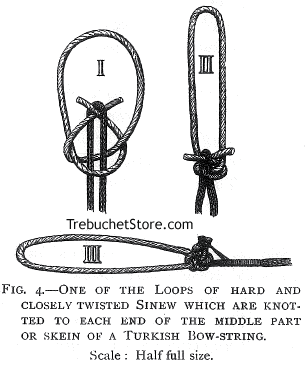
Fig. 4. - One of the Loops of Hard and Closely Twisted
Sinew which are Knotted to Each End of the Middle Part or Skein of a Turkish
Bow String. Scale: Half full size.
I. A loop and its knot as first formed on one end of the skein
of the bow-string.
II. The loop drawn up, but not tightened.
III. The loop drawn up tight and its loose ends secured.
As shown in III, the projecting ends of the length of sinew which forms
the loop are cut off to within a third of an inch of the knot. They are
singed at their extremities, so as to form small burrs which prevent the
short length of strong silk, which lashes them together, from slipping
off.
The ends of this last small lashing are placed beneath the wrapping
of silk to be seen on the skein near the knot in III.
In this way the knot of the loop is rigidly secured against any chance
of drawing when the bow is in use.
(The bow-strings of all Oriental bows, with the exception of the Tartar
and
Chinese, were made as above described.)
The Arrow
Length of arrow, 25 1/2 in. to 25 3/4 in.
Weight of arrow, avoirdupois, 7 drs., or equal to the weight of two
shillings and a sixpence.
The balance of the arrow is at 12 in. from the end of its nock.
Shape of arrow, ' barreled,' and much tapered from its balancing-point
to its ends : its sharp ivory point being only 1/8 in. in diameter (where
it is fitted to the shaft) and 1/4 in. in length. |