|
The Turkish Bow - Its
Arrow
The part of the shaft to which the feathers are attached is 3/16 in
diameter, and the centre of the shaft 5/16 in.
Though I have carefully measured and weighed about two hundred eighteenth-century
Turkish flight arrows, I have scarce found a half-dozen that were 1/8
in. more or less than from 25 1/2 in. to 25 3/4 in. in length, or that
varied by even as little as 1/2 dr. from 7 dr. in weight. In regard to
their balancing-point these arrows are equally exact, as this part is invariably
from 11 1/2 in. to 12 1/2 in. from the nock.
It is evident that the old Turkish Might arrow was made to a standard
pattern that experience showed was the best for long-distance shooting.
The light and elegantly shaped wooden nock of an old Turkish arrow (fig.
5) is quite unlike the clumsy horn nock of the modern European one.
The latter cannot withstand the recoil of the Turkish bow and soon splits
apart, though in the thousands of times I have discharged Turkish arrows
I have never known one to split at the nock.
It will be noticed that the shape of the Turkish nock - with its narrow
entrance that springs apart to admit the bow-string and then closes again
- enabled an archer, even on horse-back, to carry an arrow ready for use
on the string of his bow.
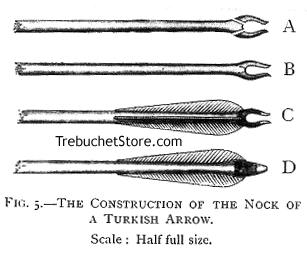
Fig. 5. - The Construction of the Nock of a Turkish
Arrow. Scale: Half full size.
A. The butt end of the arrow, with the projecting wooden halves of the
nock shaped and ready to be glued to the shaft.
B. The halves of the nock glued to the shaft.
C, D. The feathers glued to the shaft.
The feathers (3) of a Turkish flight arrow, though stiff, are as thin
as paper, and are 21/2 in. long and 1/4 in. high near the nock. They were
often made of parchment.1
The dark band of shading to be seen round the nock in C and D is a wrapping
of fine thread-like sinew. This sinew, after being soaked in hot glue,
was wound to a thickness of about 1/32 in. all over the nock and it thus
held the halves of the latter securely to the shaft.
When dry, the wrapping of sinew was cut out where it crossed the opening
for the bow-string. It nevertheless gave a great increase of strength to
the thin projecting halves of the nock, as it covered them on their outer
surfaces
1 Parchment feathering increases the range
of a flight arrow by at least thirty yards. The reason of this is, that
parchment is so thin and smooth that it offers very slight frictional resistance
to the air, whilst at the same time it is much harder, as well as much
more unyielding, than feather. |