|
The Catapult
The arrow is laid in the trough before the bowstring is stretched. (A,
B, fig. 8, p. 21)
The balistas made ready for use by turning the windlass. The windlass
pulls back the sliding trough, and the arrow resting in it, along the stock
of the engine, till the bow string is at its proper tension for discharging
the projectile. (Fig. 7, p. 19)
As the trough and the arrow are drawn back together, the arrow can be
safely laid in position before the engine is prepared for action.
The catch holding the bowstring, and the trigger for releasing it, are
fixed to the solid after end of the wooden trough. (Fig. 8, p. 21.)
The two ratchets at the side of the after-end of the trough travel over
and engage, as they pass along, the metal cogs fixed on either end of the
stock. (Fig. 8, p. 21)1
By this arrangement, the trough can be securely retained, in transit,
at any point between the one it started from and the one it attains when
drawn back to its full extent by the windlass.
As the lock and trigger of the ballista are fixed to the after end of
the sliding trough (G, fig. 8, p. 21), it will be realised that the arrow
could be discharged at any moment required in warfare, whether the bow
string was fully or only partially stretched.
In this respect the ballista differed form the crossbow, which it somewhat
resembled, as in a crossbow the bow string cannot be set free by the trigger
at any intermediate point, but only when it is drawn to the lock of the
weapon.
It will be seen that the balista derives its power from two arms; each
with its separate skein of cord and pair of winches.
These parts of the ballista are the same in their action and mechanism
as those of the catapult.
Fig. 8. (Opposite Page) The Mechanism of the Stock of an Arrow Throwing
Balista.
A. Side view of the stock, with the arrow laid in the sliding trough
before the bow string is stretched.
B. Surface view of the stock, with the arrow laid in the sliding trough
before the bow string is stretched.
C. Section of the fore-end of the stock, and of the trough which slides
in and along it.
1 When the bowstring has been released and
the arrow discharged, the ratchets are lifted clear of the cogs on the
stock of the engine. This allows the trough to be slid forward to its first
position as shown in A, B, fig. 8. p. 21. It is then ready to be drawn
back again for the next shot.
|
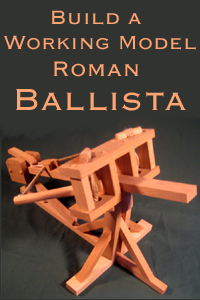 Roman
Ballista Plans Roman
Ballista Plans
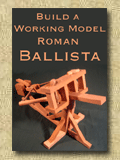
Build a Working Model Ballista with TrebuchetStore.com
Ballista Plans and Instructions. Once complete, this Stone Throwing Ballista
is 2 feet long and will throw a scale projectile up to 90 feet.
Professional Design
Professionally engineered, this Roman Ballista design allows you to
vary the elevation and bow strength for range and trajectory adjustment.
Fire with a soft projectile for indoor use, or a solid one for long range
outdoors.
Great Project
Resembling a crossbow, the ballista derives its power from skeins of
twisted cord, just like a catapult. The Stone Throwing Ballista is perfect
for demonstrating ancient Roman warfare and technology as well as the physics
of torsion, ballistics and projectile motion. Ballistas make great science
and history projects.
Easy to Build
Like all TrebuchetStore.com plans, the Ballista uses common, inexpensive
and easy to find building materials, available at your local hardware store
or home center. Basic woodworking skills and tools are required, but the
straightforward design requires no complicated layout or joinery.
TrebuchetStore.com Ballista Plans come complete with:
-
Parts Shopping List
-
Measured Drawings for all parts
-
Assembly Drawings
-
Step by step Assembly Instructions
-
Step by step Firing and Tuning Instructions
All the information you need to complete your project quickly and easily.
Want to know how to build a ballista ? TrebuchetStore.com Ballista Plans
and Instructions take the mystery out of Ballista design and construction.
|
Appendix >
Book of the Crossbow
> Ancient Projectile Engines
> Catapult > p.20 |