|
|
The
Crossbow > Chapter 2 > Sporting
Crossbow > p.11
Chapter II
The Sporting Crossbow
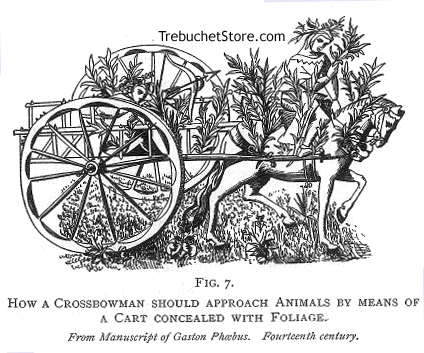
Fig. 7 - How a Crossbowman should approach animals
by means of a cart concealed with foliage.
Though the Sporting Crossbow, as was the case
with the crossbow employed in warfare, never found
as much favour in England as it did on the Continent, it was in limited
use among the nobles and gentry of the kingdom for killing deer, the extreme
accuracy of the weapon at a short range, and the heavy bolt it threw, well
adapting it for the chase. The crossbow, moreover,
could be used by the hunter as he crouched behind trees or rocks, or amid
the dense cover that formerly compassed the haunts of deer, in places where
the string of a longbow could not be fully drawn for want of space, and
when the act of doing so, were it possible, would probably alarm and drive
away the animal for which the hunter was lying in ambush. The hunter could
carry his crossbow ready bent, and then discharge
it from any position, even when lying on the ground, while the archer with
a longbow could not shoot with effect from a stooping or recumbent attitude.1
The crossbow was also noiseless as well as
powerful and accurate, and for this reason it survived - as a common weapon
of chase - the first serious introduction of the handgun for over a century
and a half - 1470-1630.
1 I find that the thick steel bow of the ancient
military, or sporting crossbow, like the spring of a gun-lock, does not'
tire ' - i.e., lose any of its power - even though it be kept bent for
two or three hours at a time.
A heavy steel bow was slightly bent in proportion to its
length, and differed in this respect from the much lighter bow of a modern
sporting crossbow. The latter is always liable to take a slight 'set,'
or permanent bend, if kept in a strained condition for more than about
ten minutes.
|
Save up to 50% with Multi-Plan Deals
|
2 Plans $19.95 FREE Shipping
- Save Over 30%
U.S. Orders Only |
|
Get a Book of Catapult and Trebuchet Plans
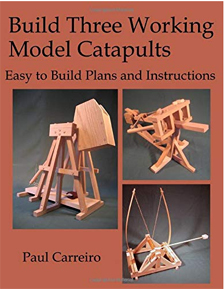
Book of Catapult Plans
On Amazon.com
"Build Three Working Model Catapults, Easy to Build Plans
and Instructions"
|
 Build Three Working Model
Catapults, Easy to Build Plans and Instructions is ideal for anyone
looking to build authentic, working model catapults.
Build Three Working Model
Catapults, Easy to Build Plans and Instructions is ideal for anyone
looking to build authentic, working model catapults.
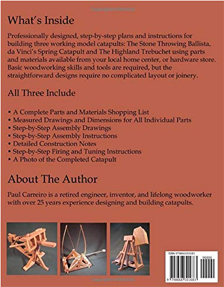
This book contains professionally designed, step-by-step plans and instructions
for building three working model catapults:
The Stone Throwing Ballista, da Vinci's Spring Catapult and The Highland
Trebuchet using parts and materials available from your local home center,
or hardware store.
The straightforward designs require no complicated layout or joinery
and include:
-
A Complete Parts and Materials Shopping List
-
Measured Drawings and Dimensions for All Individual Parts
-
Step-by-Step Assembly Drawings
-
Step-by-Step Assembly Instructions
-
Detailed Construction Notes
-
Step-by-Step Firing and Tuning Instructions
-
A Photo of the Completed Catapult
|
| Working Model Trebuchet Kit |
 |
 Trebuchet
Kit
Trebuchet
Kit
TK1
|
$75.00
FREE Shipping
U.S. Orders Only |

|
|
|
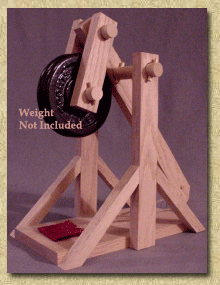
The trebuchet kit includes fully precut and drilled
frame parts, pins and axles, sling cord and sewn pouch, projectiles and
fully illustrated assembly and firing instructions.
Unlike the flimsy, snap together plywood trebuchet
kits, our all hardwood trebuchet kit does not require additional cutting,
trimming or shaping.
Requires only white carpenter's glue and a few
bar clamps (not included) to assemble.
Read
More >> |
Build a Trebuchet From Plans
 |
|
-
Materials Shopping List
-
Complete Parts List
-
Measured Drawings for All Parts
-
Step-By-Step Assembly Drawings
-
Construction Details and Notes
-
How a Trebuchet Works
-
Illustrated Firing Instructions
-
Illustrated Tuning Instructions
-
Picture of the Completed Trebuchet
|
| Fully Assembled Working Models |
|
daVinci
Trebuchet
T4 |
$299.00
FREE Shipping
U.S. Orders Only
|
|
| |
|
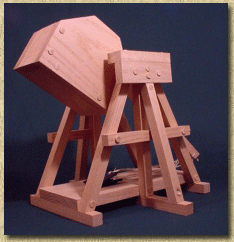
Inspired by the great war machines and siege catapults of Leonardo da Vinci
, this all Red Oak
hardwood trebuchet features
an open counterweight cabinet for range and trajectory adjustment.
Individually crafted from cabinet-grade red oak, the da Vinci Trebuchet
stands 14 inches tall in the cocked position, 24 inches tall in the fired
position and will hurl a projectile up to 60 feet. Includes six projectiles
and fully illustrated instructions.
Read
More >> |
|