|
|
The
Crossbow > Chapter 2
> Sporting Crossbow
> p.12
The Crossbow
The time and money lavished on the ornamentation of high-class sporting
crossbows,
especially those of late sixteenth-century Continental manufacture, were
very considerable, the best workers in metal, ivory and mother of pearl,
being employed in their decoration.
The stock of the sporting crossbow was often
covered with artistic representations of animals, birds and hunting scenes,
surrounded by scroll-work, all finely chased and inlaid in silver, ivory
and pearl.
The polished metal fittings of the stock, and even the hardened surfaces
of the steel bow, were sometimes deeply inlaid with a delicate tracery
in gold of leaves and flowers, or heraldic designs.
Different workmen constructed the distinct parts of a good sporting
crossbow,
just as the separate pieces of a gun are treated in these days by various
artisans, before they are fitted together to produce the weapon in its
finished state.
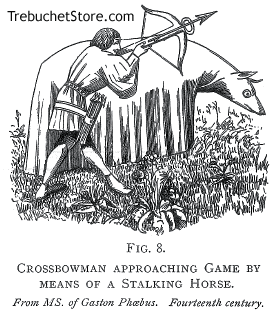
Fig. 8 - Crossbowman approaching game by means of a
stalking horse.
One set of craftsmen made the stock, another the windlass or the cranequin,
and so it was with the lock and the string ; but the most important artificers
of all were the men who forged and shaped the steel bows. The bows from
Mondragon in Spain, which were of the same quality of steel as that of
the famous Toledo sword blades, and those from Pyrmont in Germany, were
celebrated for their excellence of strength and temper.
In confirmation of this we read in Sir J. Harington's translation of
Ariosto (Italian poet, 1474-1533) :
But as a strong and justly tempered bow
Of Pyrmont steel, the more you do it bend,
Upon recoil doth give the bigger blow,
And doth with greater force the quarrel send.
(Orlando Furioso)
|
The sporting crossbow of the sixteenth century,
or from about 1500 to 1630, was no doubt a very effective weapon in its
day for the purposes for which it was required, as the experience and skill
of several centuries had brought it to perfection, ere it was at length
superseded by the improved arquebus.
The hunter could not, however, bring down birds on the wing with his
crossbow
; nor, indeed, could the man who used the arquebus of the same
The Crossbow
> Chapter 2 >
Sporting Crossbow >
p.12
|
Save up to 50% with Multi-Plan Deals
|
2 Plans $19.95 FREE Shipping
- Save Over 30%
U.S. Orders Only |
|
Get a Book of Catapult and Trebuchet Plans
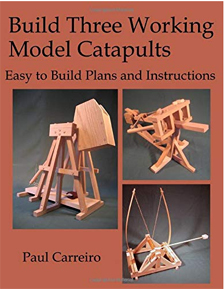
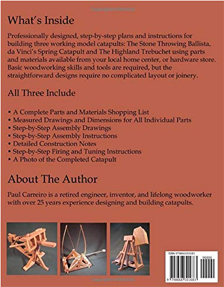
Book of Catapult Plans
On Amazon.com
"Build Three Working Model Catapults, Easy to Build Plans
and Instructions"
|
 Build Three Working Model
Catapults, Easy to Build Plans and Instructions is ideal for anyone
looking to build authentic, working model catapults.
Build Three Working Model
Catapults, Easy to Build Plans and Instructions is ideal for anyone
looking to build authentic, working model catapults.
This book contains professionally designed, step-by-step plans and instructions
for building three working model catapults:
The Stone Throwing Ballista, da Vinci's Spring Catapult and The Highland
Trebuchet using parts and materials available from your local home center,
or hardware store.
The straightforward designs require no complicated layout or joinery
and include:
-
A Complete Parts and Materials Shopping List
-
Measured Drawings and Dimensions for All Individual Parts
-
Step-by-Step Assembly Drawings
-
Step-by-Step Assembly Instructions
-
Detailed Construction Notes
-
Step-by-Step Firing and Tuning Instructions
-
A Photo of the Completed Catapult
|
| Working Model Trebuchet Kit |
 |
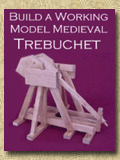
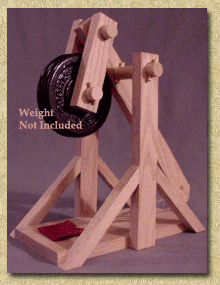 Trebuchet
Kit
Trebuchet
Kit
TK1
|
$75.00
FREE Shipping
U.S. Orders Only |

|
|
|
The trebuchet kit includes fully precut and drilled
frame parts, pins and axles, sling cord and sewn pouch, projectiles and
fully illustrated assembly and firing instructions.
Unlike the flimsy, snap together plywood trebuchet
kits, our all hardwood trebuchet kit does not require additional cutting,
trimming or shaping.
Requires only white carpenter's glue and a few
bar clamps (not included) to assemble.
Read
More >> |
Build a Trebuchet From Plans
 |
|
-
Materials Shopping List
-
Complete Parts List
-
Measured Drawings for All Parts
-
Step-By-Step Assembly Drawings
-
Construction Details and Notes
-
How a Trebuchet Works
-
Illustrated Firing Instructions
-
Illustrated Tuning Instructions
-
Picture of the Completed Trebuchet
|
| Fully Assembled Working Models |
|
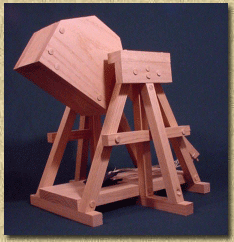
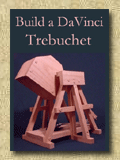
daVinci
Trebuchet
T4 |
$299.00
FREE Shipping
U.S. Orders Only
|
|
| |
|
Inspired by the great war machines and siege catapults of Leonardo da Vinci
, this all Red Oak
hardwood trebuchet features
an open counterweight cabinet for range and trajectory adjustment.
Individually crafted from cabinet-grade red oak, the da Vinci Trebuchet
stands 14 inches tall in the cocked position, 24 inches tall in the fired
position and will hurl a projectile up to 60 feet. Includes six projectiles
and fully illustrated instructions.
Read
More >> |
|