|
The Crossbow
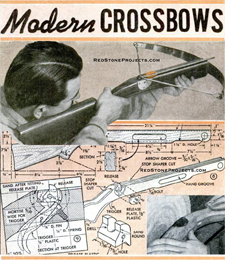
The bastard string was then removed from the bow till next required,
fig. 71.
The bastard string (in its construction similar to the bow-string) was
temporarily fixed to the arms of the steel bow by two little iron screw
clamps, fig. 70, previous page. It hung rather loosely between the clamps
when the latter were attached near the ends of the bow. The windlass was
then used to pull the bastard string tight down over the fingers of the
nut, where it was held fast whilst the bowstring was being fitted, fig.
70.
By regulating the position of the clamps on its bow, any crossbow could
be bent by its windlass just enough to enable its bow-string to be removed
or replaced.
To remove the bastard string (after having fitted the bowstring into
the notches of the bow), do not pull the trigger of the crossbow. Hold
one handle of the windlass with one hand and press the trigger at the same
time with your other hand, then let the bastard string gradually slacken
and the bowstring tighten as you reverse the windlass.
The fitted bowstring should be from 1/2 in. to 3/4 in. further along
the groove in the stock, towards the nut, than a thread would be, if stretched
between the ends of the bow whilst the latter was at rest previous to its
bow-string being put on. In this crossbow the front of the string should
be 5 in. from the inside upper edge of the centre of the bow, and the back
of the string, 6 in. from the centre of the nut.
If the fitted bow-string is a little slack, take it off the bow by means
of the bastard string. Undo the centre wrapping, give the string two or
three twists to shorten it, then replace it on the bow and wrap its centre
again.
If the string is very tight, and bends the bow too much - the string
being, for instance, 1 1/2 in. along the stock instead of from 1/2 in.
to 3/4 in. as above explained - there will be a waste of power; also a
risk of fracture when the bow is fully bent by the windlass. |