|
|
The
Crossbow > Chapter 4
> Bolts Used with Crossbows
> p.19
The Bolts Used with Crossbows
bolt of the early military crossbow was called a quarrel, a name afterwards
applied to all crossbow bolts of whatever form.1
The bolts of crossbows were not ' nocked ' at their butt-ends like the
arrows of a longbow. I have never seen any original crossbow bolts with
nocks, and from experiments of my own I find that they fly further and
with more accuracy when they have plain upright ends.
There is little doubt that a strong military crossbow, with a steel
bow, was able, at a fair range, to penetrate with a sharp-headed bolt
any armour that was worn at the time of the introduction of this weapon
into warfare, though the arrow of a longbow could not always be depended
on to do so, as its shaft was more apt to break on contact.
The bolt of a steel crossbow was a heavy
and dangerous projectile, even when at the end of its flight; far more
so than an arrow. A bolt which did not happen to penetrate armour, must
have dealt a blow sufficient to stun a man and knock him to the ground.
Even the primitive handgun, at close range,
would probably shiver with its ball the mail and armour worn at the period
when this weapon came into use.
Armour was most likely first increased in thickness, and plate generally
substituted for chain mail, in order to resist the sharp head of the arrow
of the powerful longbow. When the hand-gun was
introduced, and the crossbow with a thick steel bow perfected, breast-plates,
helmets, and other metal protections for horse and man, were still further
strengthened : so much so, that near the end of the fifteenth century they
attained a weight almost beyond the physical endurance of the knights on
horseback or the men-at-arms.
Finally plate armour was much lightened, and to a considerable extent
discontinued, in the reign of Henry VIII., as being of small avail against
gunpowder and bullets, though it was worn in its less complete form till
near the end of the seventeenth century as a protection from sword and
pike.
Though the knights, secure in their heavy armour, had no scruples in
riding down and killing the leather-clad foot-soldier, it is entertaining
to read of the fierce outcry they made when the foot-soldier retaliated
with steel crossbow and arquebus.
The knights called Heaven to witness that it was not honourable warfare
to employ such weapons in battle, the fact being that they realised that
armour was no longer the protection to their persons which it was before
the days of heavy crossbows and hand-guns.
1 Probably from quarreau, - in modern French
carreau, anything diamond-shaped or with squared faces, as was usually
the head of a crossbow bolt. 3, fig. 10.
The Crossbow
> Chapter 4 >
Bolts Used with Crossbows > p.19
|
Save up to 50% with Multi-Plan Deals
|
2 Plans $19.95 FREE Shipping
- Save Over 30%
U.S. Orders Only |
|
Get a Book of Catapult and Trebuchet Plans
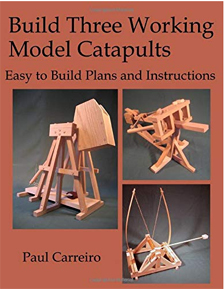
Book of Catapult Plans
On Amazon.com
"Build Three Working Model Catapults, Easy to Build Plans
and Instructions"
|
 Build Three Working Model
Catapults, Easy to Build Plans and Instructions is ideal for anyone
looking to build authentic, working model catapults.
Build Three Working Model
Catapults, Easy to Build Plans and Instructions is ideal for anyone
looking to build authentic, working model catapults.
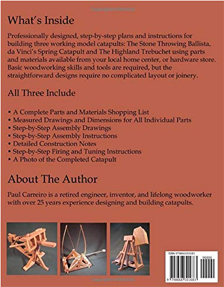
This book contains professionally designed, step-by-step plans and instructions
for building three working model catapults:
The Stone Throwing Ballista, da Vinci's Spring Catapult and The Highland
Trebuchet using parts and materials available from your local home center,
or hardware store.
The straightforward designs require no complicated layout or joinery
and include:
-
A Complete Parts and Materials Shopping List
-
Measured Drawings and Dimensions for All Individual Parts
-
Step-by-Step Assembly Drawings
-
Step-by-Step Assembly Instructions
-
Detailed Construction Notes
-
Step-by-Step Firing and Tuning Instructions
-
A Photo of the Completed Catapult
|
| Working Model Trebuchet Kit |
 |
 Trebuchet
Kit
Trebuchet
Kit
TK1
|
$75.00
FREE Shipping
U.S. Orders Only |

|
|
|
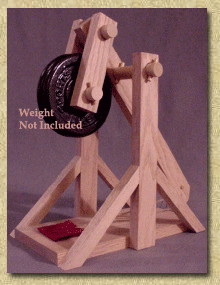
The trebuchet kit includes fully precut and drilled
frame parts, pins and axles, sling cord and sewn pouch, projectiles and
fully illustrated assembly and firing instructions.
Unlike the flimsy, snap together plywood trebuchet
kits, our all hardwood trebuchet kit does not require additional cutting,
trimming or shaping.
Requires only white carpenter's glue and a few
bar clamps (not included) to assemble.
Read
More >> |
Build a Trebuchet From Plans
 |
|
-
Materials Shopping List
-
Complete Parts List
-
Measured Drawings for All Parts
-
Step-By-Step Assembly Drawings
-
Construction Details and Notes
-
How a Trebuchet Works
-
Illustrated Firing Instructions
-
Illustrated Tuning Instructions
-
Picture of the Completed Trebuchet
|
| Fully Assembled Working Models |
|
daVinci
Trebuchet
T4 |
$299.00
FREE Shipping
U.S. Orders Only
|
|
| |
|
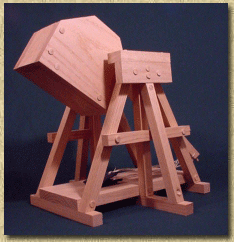
Inspired by the great war machines and siege catapults of Leonardo da Vinci
, this all Red Oak
hardwood trebuchet features
an open counterweight cabinet for range and trajectory adjustment.
Individually crafted from cabinet-grade red oak, the da Vinci Trebuchet
stands 14 inches tall in the cocked position, 24 inches tall in the fired
position and will hurl a projectile up to 60 feet. Includes six projectiles
and fully illustrated instructions.
Read
More >> |
|