|
|
The
Crossbow > Chapter 8 > Summary
of the Development of the Medieval Handgun > p.40
The Crossbow
Chapter VIII
Summary of the Development of the Medieval Hand-Gun
In the heading to this chapter, I have used the word ' handgun' to express
any hand fire-arm that was carried by the individual soldier in mediaeval
times.
Hand-guns were first seen in warfare at the end of the fourteenth century,
and were then known as hand-cannon. They were merely small reproductions
of the fire-arms or cannon which for many years previously had been employed
in sieges.
The earliest hand-gun consisted of a short metal tube, of 1/2
in. to 3/4 in. bore, with a touch-hole on the top of its breech-end, like
a cannon.
This tube was fastened to a straight piece of wood, either by means
of small iron hoops, or by thongs of leather.
The weapon was discharged by placing a burning fuse to the priming powder
which was piled up over its touch-hole. The first hand-gun was, in fact,
a miniature cannon, made light enough to be manipulated by one man, and
with a handle fastened to its breech-end by which to hold and direct it.
This form of hand-gun was in limited use in foreign armies till about 1460.
For a long time after their introduction, the smaller hand-guns had
straight narrow stocks, similar in shape to those of military
crossbows, the pointed end of the stock of the handgun, as in the larger
crossbow, being rested upon the top of the right shoulder when aim was
taken, fig. 4, p. 8.
Even the manner of sighting over the thumb, as it lay on the top of
the stock, was also copied from the crossbow, a primitive system of alignment
retained in the hand-gun for many years.
The straight crossbow-shaped stock was not generally discarded in handguns,
and the enlarged butt-end for the shoulder substituted, till about 1500.
The next variety of hand-gun was very heavy, and was known as a culverin.
Small culverins were, however, carried by horsemen, but the
The Crossbow
> Chapter 8 > Summary of the Development of the Medieval
Handgun > p.40
|
Save up to 50% with Multi-Plan Deals
|
2 Plans $19.95 FREE Shipping
- Save Over 30%
U.S. Orders Only |
|
Get a Book of Catapult and Trebuchet Plans
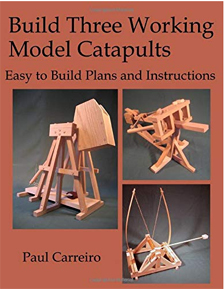
Book of Catapult Plans
On Amazon.com
"Build Three Working Model Catapults, Easy to Build Plans
and Instructions"
|
 Build Three Working Model
Catapults, Easy to Build Plans and Instructions is ideal for anyone
looking to build authentic, working model catapults.
Build Three Working Model
Catapults, Easy to Build Plans and Instructions is ideal for anyone
looking to build authentic, working model catapults.
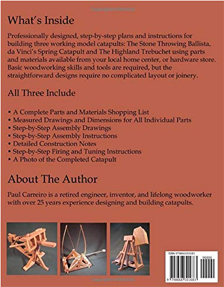
This book contains professionally designed, step-by-step plans and instructions
for building three working model catapults:
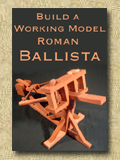
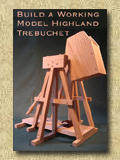
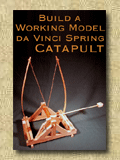
The Stone Throwing Ballista, da Vinci's Spring Catapult and The Highland
Trebuchet using parts and materials available from your local home center,
or hardware store.
The straightforward designs require no complicated layout or joinery
and include:
-
A Complete Parts and Materials Shopping List
-
Measured Drawings and Dimensions for All Individual Parts
-
Step-by-Step Assembly Drawings
-
Step-by-Step Assembly Instructions
-
Detailed Construction Notes
-
Step-by-Step Firing and Tuning Instructions
-
A Photo of the Completed Catapult
|
| Working Model Trebuchet Kit |
 |
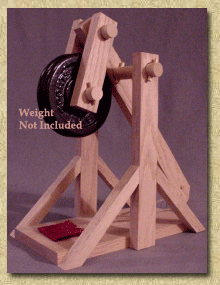 Trebuchet
Kit
Trebuchet
Kit
TK1
|
$75.00
FREE Shipping
U.S. Orders Only |

|
|
|
The trebuchet kit includes fully precut and drilled
frame parts, pins and axles, sling cord and sewn pouch, projectiles and
fully illustrated assembly and firing instructions.
Unlike the flimsy, snap together plywood trebuchet
kits, our all hardwood trebuchet kit does not require additional cutting,
trimming or shaping.
Requires only white carpenter's glue and a few
bar clamps (not included) to assemble.
Read
More >> |
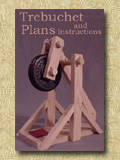
Build a Trebuchet From Plans
 |
|
-
Materials Shopping List
-
Complete Parts List
-
Measured Drawings for All Parts
-
Step-By-Step Assembly Drawings
-
Construction Details and Notes
-
How a Trebuchet Works
-
Illustrated Firing Instructions
-
Illustrated Tuning Instructions
-
Picture of the Completed Trebuchet
|
| Fully Assembled Working Models |
|
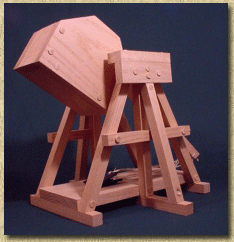
daVinci
Trebuchet
T4 |
$299.00
FREE Shipping
U.S. Orders Only
|
|
| |
|
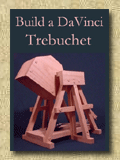
Inspired by the great war machines and siege catapults of Leonardo da Vinci
, this all Red Oak
hardwood trebuchet features
an open counterweight cabinet for range and trajectory adjustment.
Individually crafted from cabinet-grade red oak, the da Vinci Trebuchet
stands 14 inches tall in the cocked position, 24 inches tall in the fired
position and will hurl a projectile up to 60 feet. Includes six projectiles
and fully illustrated instructions.
Read
More >> |
|