|
|
The
Crossbow > Chapter 1 > Military Crossbow
> p.3
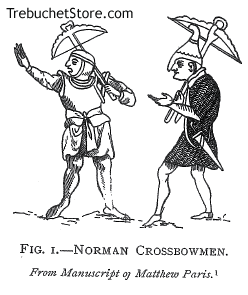
Fig 1 - Norman Crossbowmen.
The crossbow was probably introduced into England
as a military and sporting arm by Norman invaders in 1066.
Early in the twelfth century, the construction of this weapon, the bow
of which was not yet formed of steel, was so much improved that it became
very popular English ad Continental Armies.
The wounds caused by the crossbow in warfare
were, however, considered so barbarous, that its use, except against infidels,
was interdicted by the second Lateran Council, in 1139, under penalty of
anathema, as a weapon hateful to God and unfit for Christians. This prohibition
was confirmed, at the close of the same century, by Pope Innocent III.
Conrad III, of Germany, 1138 -1152, also forbad the crossbow
in his army and kingdom.
The employment of crossbowmen, nevertheless, again became common in
English and Continental armies in the reign of Richard I, 1189-1199, and
the death of this king, which was caused by the bolt from a
crossbow, (at the siege of the Castle of Chaluz, near Limogres, in
France, in 1199) was thought to be a judgment from Heaven inflicted upon
him for his disobedience and impiety in permitting crossbowmen to enter
his service.
Richard was an expert with the weapon. At the siege of Ascalon - though
prostrated with fever - he is said to have been carried from his tent on
a mattress, so the he might enjoy the pleasure of shooting bolts at the
defenders of the town. In this case, however, as the enemy consisted of
Turks and infidels, this act would have been sanctioned by the Church of
Rome. Thought among
1 As the period in which a chronicler, or artist,
lived, cannot be repeated on every occasion when his name occurs, consult,
therefore, the general index to ascertain any biographical date.
The Crossbow
> Chapter 1 > Military Crossbow > p.3
|
Save up to 50% with Multi-Plan Deals
|
2 Plans $19.95 FREE Shipping
- Save Over 30%
U.S. Orders Only |
|
Get a Book of Catapult and Trebuchet Plans
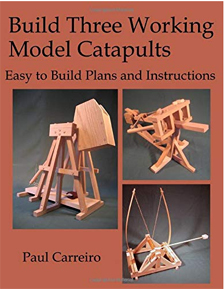
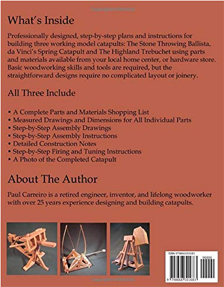
Book of Catapult Plans
On Amazon.com
"Build Three Working Model Catapults, Easy to Build Plans
and Instructions"
|
 Build Three Working Model
Catapults, Easy to Build Plans and Instructions is ideal for anyone
looking to build authentic, working model catapults.
Build Three Working Model
Catapults, Easy to Build Plans and Instructions is ideal for anyone
looking to build authentic, working model catapults.
This book contains professionally designed, step-by-step plans and instructions
for building three working model catapults:
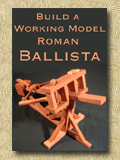
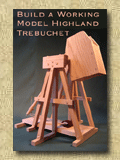
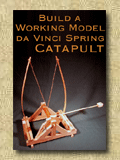
The Stone Throwing Ballista, da Vinci's Spring Catapult and The Highland
Trebuchet using parts and materials available from your local home center,
or hardware store.
The straightforward designs require no complicated layout or joinery
and include:
-
A Complete Parts and Materials Shopping List
-
Measured Drawings and Dimensions for All Individual Parts
-
Step-by-Step Assembly Drawings
-
Step-by-Step Assembly Instructions
-
Detailed Construction Notes
-
Step-by-Step Firing and Tuning Instructions
-
A Photo of the Completed Catapult
|
| Working Model Trebuchet Kit |
 |
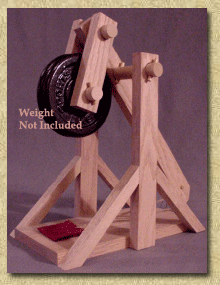 Trebuchet
Kit
Trebuchet
Kit
TK1
|
$75.00
FREE Shipping
U.S. Orders Only |

|
|
|
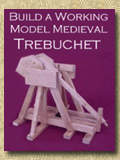
The trebuchet kit includes fully precut and drilled
frame parts, pins and axles, sling cord and sewn pouch, projectiles and
fully illustrated assembly and firing instructions.
Unlike the flimsy, snap together plywood trebuchet
kits, our all hardwood trebuchet kit does not require additional cutting,
trimming or shaping.
Requires only white carpenter's glue and a few
bar clamps (not included) to assemble.
Read
More >> |
Build a Trebuchet From Plans
 |
|
-
Materials Shopping List
-
Complete Parts List
-
Measured Drawings for All Parts
-
Step-By-Step Assembly Drawings
-
Construction Details and Notes
-
How a Trebuchet Works
-
Illustrated Firing Instructions
-
Illustrated Tuning Instructions
-
Picture of the Completed Trebuchet
|
Build a Trebuchet From Plans
|
|
-
Materials Shopping List
-
Complete Parts List
-
Measured Drawings for All Parts
-
Step-By-Step Assembly Drawings
-
Construction Details and Notes
-
How a Trebuchet Works
-
Illustrated Firing Instructions
-
Illustrated Tuning Instructions
-
Picture of the Completed Trebuchet
|
| Fully Assembled Working Models |
|
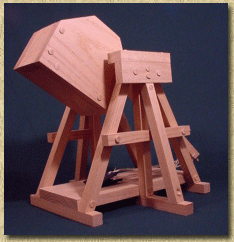
daVinci
Trebuchet
T4 |
$299.00
FREE Shipping
U.S. Orders Only
|
|
| |
|
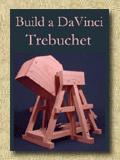
Inspired by the great war machines and siege catapults of Leonardo da Vinci
, this all Red Oak
hardwood trebuchet features
an open counterweight cabinet for range and trajectory adjustment.
Individually crafted from cabinet-grade red oak, the da Vinci Trebuchet
stands 14 inches tall in the cocked position, 24 inches tall in the fired
position and will hurl a projectile up to 60 feet. Includes six projectiles
and fully illustrated instructions.
Read
More >> |
|