|
|
The
Crossbow > Chapter 1 > Military
Crossbow > p.4
The Crossbow
English soldiers, the longbow began to supersede the crossbow
and the shortbow, during the reign of Edward I in the last few years of
the thirteenth century, crossbow continued to
be held in some favour in our armies. In the list of troops mustered by
Edward II, in 1319, for the siege of Berwick, crossbowmen are enumerated
as part of the forces. In Scotland and Ireland, the crossbowmen were almost
unknown, and even the bow was sparingly used, though in Wales, as in England,
the latter was the common arm of the people in the fourteenth and fifteenth
centuries.
For about two centuries and a half (1200-1460) the crossbow
was the favourite weapon on the Continent. It was almost equally popular
with English commanders and soldiers till about 1290, and several estates
in this country were by the service of delivering a crossbow
when the king passed through them.
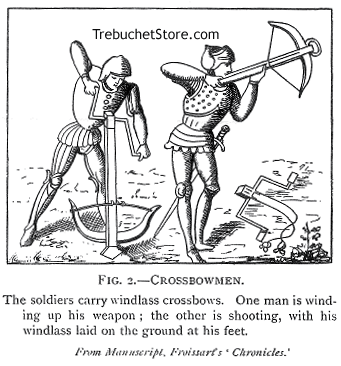
Fig 2. - Crossbowmen
The Soldiers carry windlass crossbows. One man is winding
up his weapon ; the other is shooting, with his windlass laid on
the ground at his feet.
The Genoese were always famed for their skill in the construction and
management of crossbows, and were hired for service
by sea, land and all the nations on the Continent. They are said to have
used these weapons with success, even as early as 1099 at the siege of
Jerusalem. In the naval engagement near Sluys, in Holland, where Edward
III defeated the French in 1340, the latter had as many 20,000 Genoese
crossbowmen on their ships, and the largest number of crossbowmen ever
seen in order of battle on land, were probably the 15,000 Genoese who,
according to Froissart1, formed the front rank of the French
army at Crecy in 1346. It is asserted by numerous historians, all of whom
derive their information on the subject who derive their information on
the subject from a cursory statement by the second continuator of William
of Nangis2, that the crossbowmen at Crecy were unable to shoot
with effect, because the strings of their weapons were slack owing to the
great storm of rain that set in just before the battle. Muratori3,
the Italian antiquary, declares that the
1 Sir John Froissart - French chronicler, born
about 1337, died about 1410.
2 William of Nangis - French historian, a
Benedictine monk of the Abbey of St. Denis, flourished in the thirteenth
century, wrote a history of the kings of France, died 1300.
3 Muratori -Italian priest and historian,
born 1672, died 1750.
The Crossbow
> Chapter 1 > Military
Crossbow > p.4
|
Save up to 50% with Multi-Plan Deals
|
2 Plans $19.95 FREE Shipping
- Save Over 30%
U.S. Orders Only |
|
Get a Book of Catapult and Trebuchet Plans
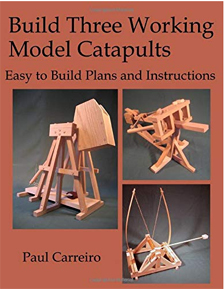
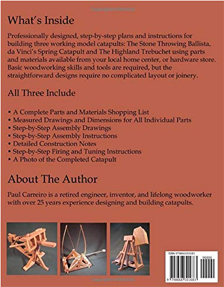
Book of Catapult Plans
On Amazon.com
"Build Three Working Model Catapults, Easy to Build Plans
and Instructions"
|
 Build Three Working Model
Catapults, Easy to Build Plans and Instructions is ideal for anyone
looking to build authentic, working model catapults.
Build Three Working Model
Catapults, Easy to Build Plans and Instructions is ideal for anyone
looking to build authentic, working model catapults.
This book contains professionally designed, step-by-step plans and instructions
for building three working model catapults:
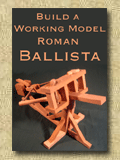
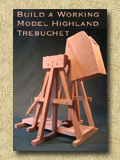
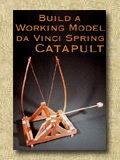
The Stone Throwing Ballista, da Vinci's Spring Catapult and The Highland
Trebuchet using parts and materials available from your local home center,
or hardware store.
The straightforward designs require no complicated layout or joinery
and include:
-
A Complete Parts and Materials Shopping List
-
Measured Drawings and Dimensions for All Individual Parts
-
Step-by-Step Assembly Drawings
-
Step-by-Step Assembly Instructions
-
Detailed Construction Notes
-
Step-by-Step Firing and Tuning Instructions
-
A Photo of the Completed Catapult
|
| Working Model Trebuchet Kit |
 |
 Trebuchet
Kit
Trebuchet
Kit
TK1
|
$75.00
FREE Shipping
U.S. Orders Only |

|
|
|
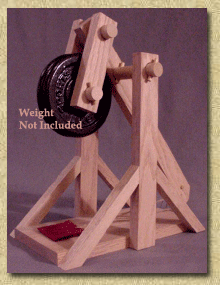
The trebuchet kit includes fully precut and drilled
frame parts, pins and axles, sling cord and sewn pouch, projectiles and
fully illustrated assembly and firing instructions.
Unlike the flimsy, snap together plywood trebuchet
kits, our all hardwood trebuchet kit does not require additional cutting,
trimming or shaping.
Requires only white carpenter's glue and a few
bar clamps (not included) to assemble.
Read
More >> |
Build a Trebuchet From Plans
 |
|
-
Materials Shopping List
-
Complete Parts List
-
Measured Drawings for All Parts
-
Step-By-Step Assembly Drawings
-
Construction Details and Notes
-
How a Trebuchet Works
-
Illustrated Firing Instructions
-
Illustrated Tuning Instructions
-
Picture of the Completed Trebuchet
|
Build a Trebuchet From Plans
|
|
-
Materials Shopping List
-
Complete Parts List
-
Measured Drawings for All Parts
-
Step-By-Step Assembly Drawings
-
Construction Details and Notes
-
How a Trebuchet Works
-
Illustrated Firing Instructions
-
Illustrated Tuning Instructions
-
Picture of the Completed Trebuchet
|
| Fully Assembled Working Models |
|
daVinci
Trebuchet
T4 |
$299.00
FREE Shipping
U.S. Orders Only
|
|
| |
|
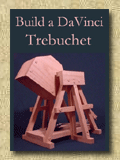
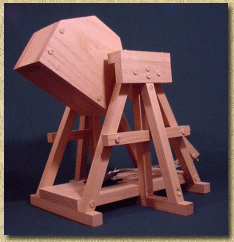
Inspired by the great war machines and siege catapults of Leonardo da Vinci
, this all Red Oak
hardwood trebuchet features
an open counterweight cabinet for range and trajectory adjustment.
Individually crafted from cabinet-grade red oak, the da Vinci Trebuchet
stands 14 inches tall in the cocked position, 24 inches tall in the fired
position and will hurl a projectile up to 60 feet. Includes six projectiles
and fully illustrated instructions.
Read
More >> |
|