|
|
The
Crossbow > Chapter 1
> Military Crossbow >
p.5
The Military Crossbow
ground at Crecy was so boggy that the crossbowmen could not stand firm
when they endevoured to stretch the strings of their weapons ; but as the
field of Crecy consists of rather steep downs, and not of lowland, it is
not probable that the state of the ground impeded the crossbowmen.
Although much doubt has been thrown on the statement that the crossbows
of Genoese failed to act on this occasion, owing to their strings being
slackened by wet weather, it is possible that the incident occurred, without,
however, in any measure influencing the result of the battle.
The string might easily have been rendered less effective than usual
by the heavy rain that fell just before the battle, and by the bright sun
which is known to have succeeded the rain.
This combination of water and heat would certainly relax in some degree
the strings of the crossbows used at the time
of Crecy, if they were uncovered, and would make the strings too loose
to be of good service, till they could be removed from the bows in order
to be shortened by twisting, and then replaced ; all of which would entail,
of course, time and care.
It should be remembered that the bows of the Genoese crossbowmen at
Crecy were doubtless composite ones, made of wood, horn, sinew and glue,
bow of steel being of latter introduction.
The composite bow was straight, hence its bowstring was fixed to it
in a necessarily rather slack condition ; for this reason the thread composing
its string, being more or less detached, were liable to absorb moisture.
On the other hand, the threads that composed the tightly strained string
of a steel crossbow, lay closely packed together,
and a in this case the string was always thickly smeared, both inside and
outside, with beeswax to preserve it, it was impervious to water.
To test the matter, I have sunk a steel crossbow
in a tank of water for a day and a night and have found no appreciable
alteration in the tightness of its string. I have also placed in water
a crossbow with a comparatively loose string - such as those which I believe
were used by the Genoese at Crecy - and found that after half an hour's
submersion, the application of a lever to bend the bow caused the string
subsequently to stretch down the stock an inch further than its proper
position, its tautness, and consequent effectiveness, thus being lost.
The supposition that the crossbow of the Genoese
at Crecy had bows of wood, or of wood and horn, is confirmed in a curious
way by David-ap-Gwilyn, the famous Welsh bard and archer of the fourteenth
century. In one of his poems, the bard refers to a soldier who had sailed
with Edward III to fight at Crecy, and whom he had cause to hate, as he
had supplanted the poet in the affections of his mistress.
The poet calls upon the enemy to shoot his more
The Crossbow
> Chapter 1 > Military
Crossbow > p.5
|
Save up to 50% with Multi-Plan Deals
|
2 Plans $19.95 FREE Shipping
- Save Over 30%
U.S. Orders Only |
|
Get a Book of Catapult and Trebuchet Plans
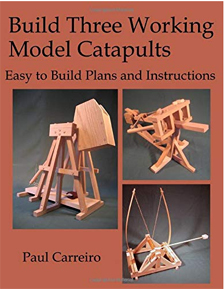

Book of Catapult Plans
On Amazon.com
"Build Three Working Model Catapults, Easy to Build Plans
and Instructions"
|
 Build Three Working Model
Catapults, Easy to Build Plans and Instructions is ideal for anyone
looking to build authentic, working model catapults.
Build Three Working Model
Catapults, Easy to Build Plans and Instructions is ideal for anyone
looking to build authentic, working model catapults.
This book contains professionally designed, step-by-step plans and instructions
for building three working model catapults:
The Stone Throwing Ballista, da Vinci's Spring Catapult and The Highland
Trebuchet using parts and materials available from your local home center,
or hardware store.
The straightforward designs require no complicated layout or joinery
and include:
-
A Complete Parts and Materials Shopping List
-
Measured Drawings and Dimensions for All Individual Parts
-
Step-by-Step Assembly Drawings
-
Step-by-Step Assembly Instructions
-
Detailed Construction Notes
-
Step-by-Step Firing and Tuning Instructions
-
A Photo of the Completed Catapult
|
| Working Model Trebuchet Kit |
 |
 Trebuchet
Kit
Trebuchet
Kit
TK1
|
$75.00
FREE Shipping
U.S. Orders Only |

|
|
|
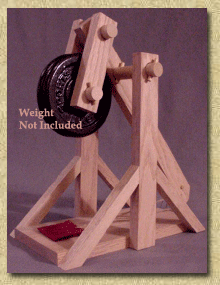
The trebuchet kit includes fully precut and drilled
frame parts, pins and axles, sling cord and sewn pouch, projectiles and
fully illustrated assembly and firing instructions.
Unlike the flimsy, snap together plywood trebuchet
kits, our all hardwood trebuchet kit does not require additional cutting,
trimming or shaping.
Requires only white carpenter's glue and a few
bar clamps (not included) to assemble.
Read
More >> |
Build a Trebuchet From Plans
 |
|
-
Materials Shopping List
-
Complete Parts List
-
Measured Drawings for All Parts
-
Step-By-Step Assembly Drawings
-
Construction Details and Notes
-
How a Trebuchet Works
-
Illustrated Firing Instructions
-
Illustrated Tuning Instructions
-
Picture of the Completed Trebuchet
|
Build a Trebuchet From Plans
|
|
-
Materials Shopping List
-
Complete Parts List
-
Measured Drawings for All Parts
-
Step-By-Step Assembly Drawings
-
Construction Details and Notes
-
How a Trebuchet Works
-
Illustrated Firing Instructions
-
Illustrated Tuning Instructions
-
Picture of the Completed Trebuchet
|
| Fully Assembled Working Models |
|
daVinci
Trebuchet
T4 |
$299.00
FREE Shipping
U.S. Orders Only
|
|
| |
|
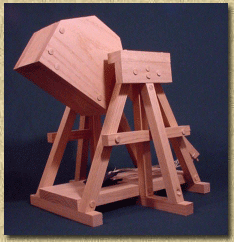
Inspired by the great war machines and siege catapults of Leonardo da Vinci
, this all Red Oak
hardwood trebuchet features
an open counterweight cabinet for range and trajectory adjustment.
Individually crafted from cabinet-grade red oak, the da Vinci Trebuchet
stands 14 inches tall in the cocked position, 24 inches tall in the fired
position and will hurl a projectile up to 60 feet. Includes six projectiles
and fully illustrated instructions.
Read
More >> |
|