|
|
The
Crossbow > Chapter 1 >
Military Crossbow > p.6
The Crossbow
fortunate rival, with the "arbalest" or short stirrup stick. The translation
of this passage, as rendered by A.J. Johns (the italics are mine), runs:
And thou crossbowman true and good,
Thou shooter with a faultless wood,
Haste with thy stirrup fashioned bow
To lay the hideous varlet low.
As further proof that at Crecy the Genoese did not use the powerful
steel crossbow which was bent by a windlass, I
quote the following extract from Viollet-le-Duc (Dictionnaire raisonne
du Mobilier francais. Paris 1868-75). "John II, King of France (the Good),
issued in 1351 a military regulation which ordered that the crossbowman
who had a good crossbow, strong according to his
strength, should receive three sous tournoise wages per day." This plainly
shows that the military crossbow of the time of
Crecy was bent either by hand alone, or, as was more probable, by a thong
and pulley, a claw fixed to the girdle, or by means of a goat's foot lever.
If the crossbowmen referred to it in the regulation given above had steel
crossbows with windlasses, such as were commonly used toward the end of
the century, the question of regulating the power of the bow to the strength
of the soldier would not have arisen, as with the windlass a boy could
bend the thickest of steel bows.
The Genoese at Crecy (they were in the first line and were the only
troops in the French army who advanced toward the English in fair order)
were probably checked, and thrown into confusion, by showers of arrows,
before they could approach their assailants sufficiently near to discharge
one crossbow bolt with effect1. All
contemporary and later evidence tends to prove, that the crossbows carried
by the Genoese at Crecy had not steel bows; thus they could not compete
at all with the English longbow, as they had formally done with the old
shortbow.
The Genoese became, therefore, a large and helpless target for the English
bowmen, and very soon scattered and fled, for they were unable to inflict
any lose upon their opponents, though struck down in numbers themselves.
This, in itself, was sufficient to throw these unfortunate mercenaries
into a state of panic, even if their small crossbows
been in proper condition, as indeed they may have been, notwithstanding
tradition and surmise to the contrary.
When the crowding mass of horse and foot, which for several miles had
been pressing in disorder on the hells of the Genoese, came up, they found
the crossbowmen in hot retreat, either by reason of the deadly hail of
English arrows they had just encountered, or because of the uselessness
of their weapons.
The cavalry, however, in merciless manner, galloped furiously over the
1 It is probable that the crossbows carried
by the Genoese at Crecy were unable to send their bolts further than about
200 yards.
The Crossbow
> Chapter 1 > Military
Crossbow > p.6
|
Save up to 50% with Multi-Plan Deals
|
2 Plans $19.95 FREE Shipping
- Save Over 30%
U.S. Orders Only |
|
Get a Book of Catapult and Trebuchet Plans
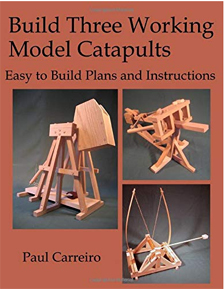
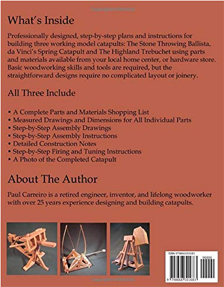
Book of Catapult Plans
On Amazon.com
"Build Three Working Model Catapults, Easy to Build Plans
and Instructions"
|
 Build Three Working Model
Catapults, Easy to Build Plans and Instructions is ideal for anyone
looking to build authentic, working model catapults.
Build Three Working Model
Catapults, Easy to Build Plans and Instructions is ideal for anyone
looking to build authentic, working model catapults.
This book contains professionally designed, step-by-step plans and instructions
for building three working model catapults:
The Stone Throwing Ballista, da Vinci's Spring Catapult and The Highland
Trebuchet using parts and materials available from your local home center,
or hardware store.
The straightforward designs require no complicated layout or joinery
and include:
-
A Complete Parts and Materials Shopping List
-
Measured Drawings and Dimensions for All Individual Parts
-
Step-by-Step Assembly Drawings
-
Step-by-Step Assembly Instructions
-
Detailed Construction Notes
-
Step-by-Step Firing and Tuning Instructions
-
A Photo of the Completed Catapult
|
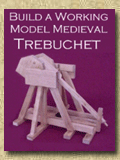
| Working Model Trebuchet Kit |
 |
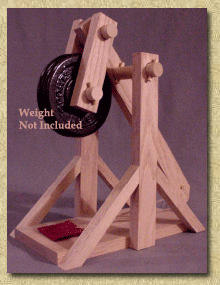 Trebuchet
Kit
Trebuchet
Kit
TK1
|
$75.00
FREE Shipping
U.S. Orders Only |

|
|
|
The trebuchet kit includes fully precut and drilled
frame parts, pins and axles, sling cord and sewn pouch, projectiles and
fully illustrated assembly and firing instructions.
Unlike the flimsy, snap together plywood trebuchet
kits, our all hardwood trebuchet kit does not require additional cutting,
trimming or shaping.
Requires only white carpenter's glue and a few
bar clamps (not included) to assemble.
Read
More >> |
Build a Trebuchet From Plans
 |
|
-
Materials Shopping List
-
Complete Parts List
-
Measured Drawings for All Parts
-
Step-By-Step Assembly Drawings
-
Construction Details and Notes
-
How a Trebuchet Works
-
Illustrated Firing Instructions
-
Illustrated Tuning Instructions
-
Picture of the Completed Trebuchet
|
Build a Trebuchet From Plans
|
|
-
Materials Shopping List
-
Complete Parts List
-
Measured Drawings for All Parts
-
Step-By-Step Assembly Drawings
-
Construction Details and Notes
-
How a Trebuchet Works
-
Illustrated Firing Instructions
-
Illustrated Tuning Instructions
-
Picture of the Completed Trebuchet
|
| Fully Assembled Working Models |
|
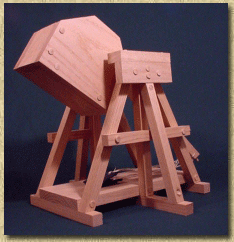
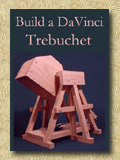
daVinci
Trebuchet
T4 |
$299.00
FREE Shipping
U.S. Orders Only
|
|
| |
|
Inspired by the great war machines and siege catapults of Leonardo da Vinci
, this all Red Oak
hardwood trebuchet features
an open counterweight cabinet for range and trajectory adjustment.
Individually crafted from cabinet-grade red oak, the da Vinci Trebuchet
stands 14 inches tall in the cocked position, 24 inches tall in the fired
position and will hurl a projectile up to 60 feet. Includes six projectiles
and fully illustrated instructions.
Read
More >> |
|