|
|
The
Crossbow > Chapter 8
> Development of the Medieval Handgun
> p.41
Development of the
Medieval Handgun
larger kind, which weighed from 16 to 18 lbs. and was used by the foot-soldier,
required the assistance of an attendant to work it.
The butt-end of the stock of the culverin was sloped downwards like
the handle of a pistol.
The culverin was at length made sufficiently portable to be worked by
the soldier himself, and was then known as an arquebus. It was further
improved by having its touch-hole bored at one side of its barrel instead
of on the top, and it was also fitted with a projecting flash-pan, placed
level with the touch-hole. This pan held more conveniently the very liberal
pinch of priming powder which, on being flashed by means of a burning-fuse
applied by hand, ignited the main charge inside the barrel. At the battle
of Morat in 1476, the Swiss had 6,000 men armed with these weapons.
Both the large culverin and the smaller one known as an arquebus, were
aimed and fired with their barrels resting on a forked stick.
Between 1510 and 1520 the arquebus above described was superseded by
the match-lock arquebus. In this kind of hand-gun the first attempt at
automatic ignition appears. It had a long hammer, pivoted in the stock,
which held a piece of slow-match in its jaws. The hammer was continued
in one piece through the stock, and projected beneath it in the form of
a trigger.
When the trigger was pulled back, its upper half, or hammer-end, pressed
down the burning fuse it held, till the fuse touched the priming powder
in the pan, and thus fired (or did not, according to the weather and other
conditions) the weapon. It is probable that during a battle, the fuse held
by the hammer of the match-lock had to be continually rekindled by the
soldier to keep it in serviceable order.
The match-lock arquebus is even now to be seen in the hands of some
remote tribes of northern India.
The wheel-lock was invented 1550-1560. This hand-gun had a small wheel,
about the size of a crown piece, and 1/4 inch thick, which revolved
at the side of its barrel. The upper edge of this wheel slightly projected,
from underneath, through the centre of the flash-pan, near the touch-hole.
The wheel had a serrated edge like a coarse file, and on one side of it
there was a strong circular spring, and a catch to secure it when it was
wound up.
The hammer of the wheel-lock gun held a piece of detonating composition
or pyrite, which on being rubbed against rough metal emitted sparks
he Crossbow
> Chapter 8 >
Development
of the Medieval Handgun > p.41
|
Save up to 50% with Multi-Plan Deals
|
2 Plans $19.95 FREE Shipping
- Save Over 30%
U.S. Orders Only |
|
Get a Book of Catapult and Trebuchet Plans
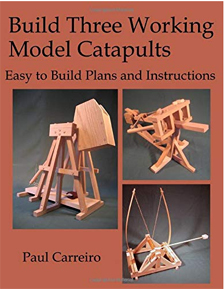
Book of Catapult Plans
On Amazon.com
"Build Three Working Model Catapults, Easy to Build Plans
and Instructions"
|
 Build Three Working Model
Catapults, Easy to Build Plans and Instructions is ideal for anyone
looking to build authentic, working model catapults.
Build Three Working Model
Catapults, Easy to Build Plans and Instructions is ideal for anyone
looking to build authentic, working model catapults.
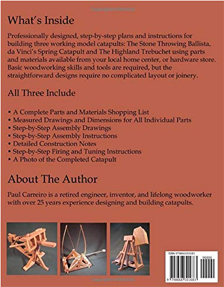
This book contains professionally designed, step-by-step plans and instructions
for building three working model catapults:
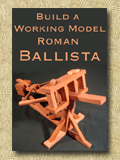
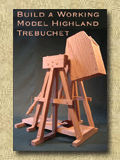
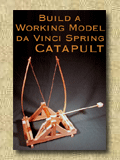
The Stone Throwing Ballista, da Vinci's Spring Catapult and The Highland
Trebuchet using parts and materials available from your local home center,
or hardware store.
The straightforward designs require no complicated layout or joinery
and include:
-
A Complete Parts and Materials Shopping List
-
Measured Drawings and Dimensions for All Individual Parts
-
Step-by-Step Assembly Drawings
-
Step-by-Step Assembly Instructions
-
Detailed Construction Notes
-
Step-by-Step Firing and Tuning Instructions
-
A Photo of the Completed Catapult
|
| Working Model Trebuchet Kit |
 |
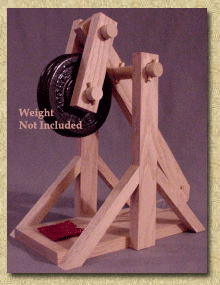 Trebuchet
Kit
Trebuchet
Kit
TK1
|
$75.00
FREE Shipping
U.S. Orders Only |

|
|
|
The trebuchet kit includes fully precut and drilled
frame parts, pins and axles, sling cord and sewn pouch, projectiles and
fully illustrated assembly and firing instructions.
Unlike the flimsy, snap together plywood trebuchet
kits, our all hardwood trebuchet kit does not require additional cutting,
trimming or shaping.
Requires only white carpenter's glue and a few
bar clamps (not included) to assemble.
Read
More >> |
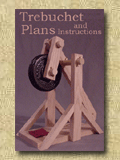
Build a Trebuchet From Plans
 |
|
-
Materials Shopping List
-
Complete Parts List
-
Measured Drawings for All Parts
-
Step-By-Step Assembly Drawings
-
Construction Details and Notes
-
How a Trebuchet Works
-
Illustrated Firing Instructions
-
Illustrated Tuning Instructions
-
Picture of the Completed Trebuchet
|
| Fully Assembled Working Models |
|
daVinci
Trebuchet
T4 |
$299.00
FREE Shipping
U.S. Orders Only
|
|
| |
|
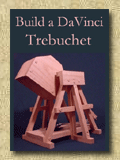
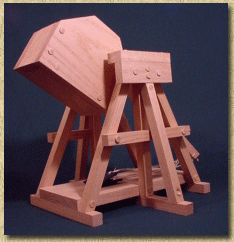
Inspired by the great war machines and siege catapults of Leonardo da Vinci
, this all Red Oak
hardwood trebuchet features
an open counterweight cabinet for range and trajectory adjustment.
Individually crafted from cabinet-grade red oak, the da Vinci Trebuchet
stands 14 inches tall in the cocked position, 24 inches tall in the fired
position and will hurl a projectile up to 60 feet. Includes six projectiles
and fully illustrated instructions.
Read
More >> |
|