|
|
The
Crossbow > Chapter 8
> Development of the Medieval Handgun
> p.42
The Crossbow
like a flint. When the wheel-lock was in use its hammer was not raised,
but - by means of a spring which kept it down - was always pressing the
pyrite it held, hard against the top of the serrated wheel, where the latter
projected through the flash-pan near the touch-hole.
To prepare the wheel-lock for firing, its wheel was turned round a couple
of times with a key, till it was secured by the small catch which prevented
its spring from unwinding it. The priming powder was next dropped into
the flash-pan.
On pulling the trigger, the wheel was set free, and rapidly revolved.
The serrated edge of the wheel, grinding hard against the composition held
in the jaws of the hammer, created the sparks which fired the priming,
and the charge inside the barrel.
The fire-lock, or flint-lock, was produced in Spain about 1625, and
was at first a mere adaptation of the wheel-lock, a piece of flint being
fixed in the end of the hammer instead of the pyrite. After a short time,
the revolving wheel was discarded, and the inside of the flash-pan was
made rough, so as to cause the edge of the flint to break against it on
the fall of the hammer, and to emit sparks.
Unlike the wheel-lock ; the hammer was now cocked and released every
time the weapon was discharged, the springs of the lock acting as in a
modern gun.
It was not till 1670-1680, that the flint-lock was sufficiently improved
to become generally adopted in war and in the chase.1
For some years, the priming in the flash-pan of a flint-lock was exposed
to wind and wet, though finally a snap cover was invented to shield the
pan and keep the priming dry. The flint was now made to strike against
the roughened surface of the inside face of this hinged cover. As the flint
struck the cover it knocked it back, and at the same time exposed the flash-pan
underneath it, and projected the sparks caused by the friction of contact
into the priming.
Flint-locks were introduced into England 1690-1700, and, with slight
modifications, were carried by our soldiers till 1840.
1 At the battle of Dunbar in 1650, the Cromwellian
musketeers carried match-locks, in preference to wheel-locks or flint-locks.
It is, however, recorded that they could not use their
weapons with full effect, as the heavy rain prevented the fuses from being
kept alight.
The Crossbow
> Chapter 8 >
Development of the Medieval Handgun
> p.42
|
Save up to 50% with Multi-Plan Deals
|
2 Plans $19.95 FREE Shipping
- Save Over 30%
U.S. Orders Only |
|
Get a Book of Catapult and Trebuchet Plans
Book of Catapult Plans
On Amazon.com
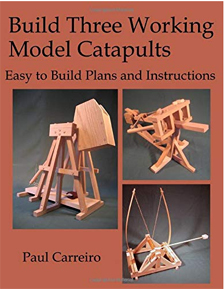
"Build Three Working Model Catapults, Easy to Build Plans
and Instructions"
|
 Build Three Working Model
Catapults, Easy to Build Plans and Instructions is ideal for anyone
looking to build authentic, working model catapults.
Build Three Working Model
Catapults, Easy to Build Plans and Instructions is ideal for anyone
looking to build authentic, working model catapults.
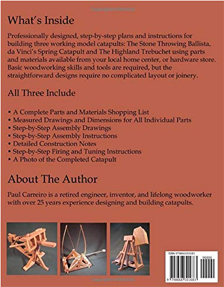
This book contains professionally designed, step-by-step plans and instructions
for building three working model catapults:
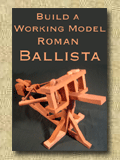
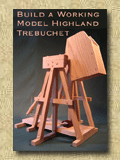
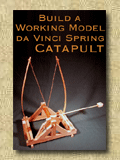
The Stone Throwing Ballista, da Vinci's Spring Catapult and The Highland
Trebuchet using parts and materials available from your local home center,
or hardware store.
The straightforward designs require no complicated layout or joinery
and include:
-
A Complete Parts and Materials Shopping List
-
Measured Drawings and Dimensions for All Individual Parts
-
Step-by-Step Assembly Drawings
-
Step-by-Step Assembly Instructions
-
Detailed Construction Notes
-
Step-by-Step Firing and Tuning Instructions
-
A Photo of the Completed Catapult
|
| Working Model Trebuchet Kit |
 |
 Trebuchet
Kit
Trebuchet
Kit
TK1
|
$75.00
FREE Shipping
U.S. Orders Only |

|
|
|
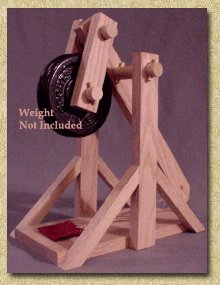
The trebuchet kit includes fully precut and drilled
frame parts, pins and axles, sling cord and sewn pouch, projectiles and
fully illustrated assembly and firing instructions.
Unlike the flimsy, snap together plywood trebuchet
kits, our all hardwood trebuchet kit does not require additional cutting,
trimming or shaping.
Requires only white carpenter's glue and a few
bar clamps (not included) to assemble.
Read
More >> |
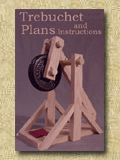
Build a Trebuchet From Plans
 |
|
-
Materials Shopping List
-
Complete Parts List
-
Measured Drawings for All Parts
-
Step-By-Step Assembly Drawings
-
Construction Details and Notes
-
How a Trebuchet Works
-
Illustrated Firing Instructions
-
Illustrated Tuning Instructions
-
Picture of the Completed Trebuchet
|
| Fully Assembled Working Models |
|
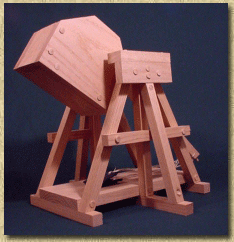
daVinci
Trebuchet
T4 |
$299.00
FREE Shipping
U.S. Orders Only
|
|
| |
|
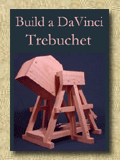
Inspired by the great war machines and siege catapults of Leonardo da Vinci
, this all Red Oak
hardwood trebuchet features
an open counterweight cabinet for range and trajectory adjustment.
Individually crafted from cabinet-grade red oak, the da Vinci Trebuchet
stands 14 inches tall in the cocked position, 24 inches tall in the fired
position and will hurl a projectile up to 60 feet. Includes six projectiles
and fully illustrated instructions.
Read
More >> |
|