The
Crossbow > Chapter 52
> Antiquity of Balistas and Catapults
> p.264
Ancient Siege Engines
The final appearance of the catapult in warfare occurred during the
siege of Gibraltar by the French and Spanish fleets, 1779-82.
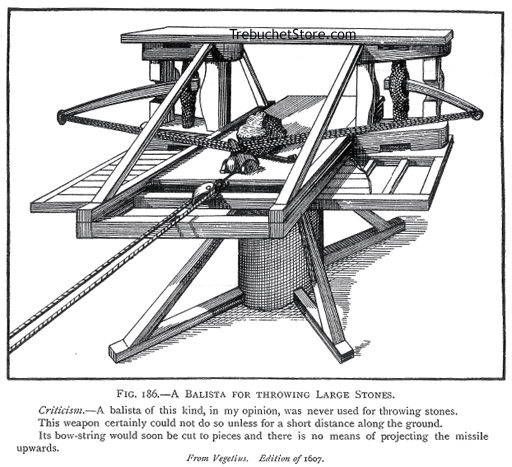
Fig. 186. - A Balista for Throwing Large Stones.
Criticism. A balista of this kind, in my opinion,
was never used for throwing stones. This weapon certainly could not do
so unless for a short distance along, the ground. Its bowstring would soon
be cut to pieces and there is no means for projecting the missile upwards.
On this occasion General Melville,1 at the desire of Lord
Heathfield,2 caused a catapult to be made for projecting heavy
stones over the edge of the precipice, so that they might fall on a ledge
of rock frequented by the Spaniards where shells from mortars could not
be aimed to reach them.
1 General Robert Melville, soldier and antiquary,
born 1723, died 1809. He invented the carronade for use on board ships
of war.
2 General George Eliot, created Lord Heathfield,
1787, for his successful defence of Gibraltar against the French and Spanish
fleets, 1779-1782. His portrait by Sir Joshua Reynolds is in the National
Gallery, London.
|
 Roman
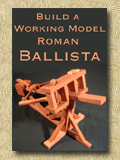
Ballista Plans Roman
Ballista Plans
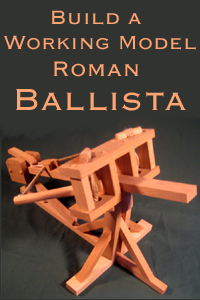
Build a Working Model Ballista with TrebuchetStore.com
Ballista Plans and Instructions. Once complete, this Stone Throwing Ballista
is 2 feet long and will throw a scale projectile up to 90 feet.
Professional Design
Professionally engineered, this Roman Ballista design allows you to
vary the elevation and bow strength for range and trajectory adjustment.
Fire with a soft projectile for indoor use, or a solid one for long range
outdoors.
Great Project
Resembling a crossbow, the ballista derives its power from skeins of
twisted cord, just like a catapult. The Stone Throwing Ballista is perfect
for demonstrating ancient Roman warfare and technology as well as the physics
of torsion, ballistics and projectile motion. Ballistas make great science
and history projects.
Easy to Build
Like all TrebuchetStore.com plans, the Ballista uses common, inexpensive
and easy to find building materials, available at your local hardware store
or home center. Basic woodworking skills and tools are required, but the
straightforward design requires no complicated layout or joinery.
TrebuchetStore.com Ballista Plans come complete with:
-
Parts Shopping List
-
Measured Drawings for all parts
-
Assembly Drawings
-
Step by step Assembly Instructions
-
Step by step Firing and Tuning Instructions
All the information you need to complete your project quickly and easily.
Want to know how to build a ballista ? TrebuchetStore.com Ballista Plans
and Instructions take the mystery out of Ballista design and construction. |
The Crossbow
> Chapter 52 > Antiquity
of Balistas and Catapults > p.264
|
Save up to 50% with Multi-Plan Deals
|
2 Plans $19.95 FREE Shipping
- Save Over 30%
U.S. Orders Only |
|
Get a Book of Catapult and Trebuchet Plans
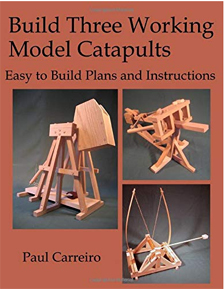
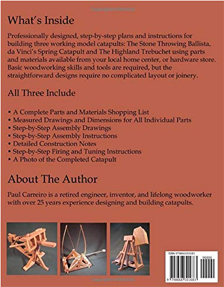
Book of Catapult Plans
On Amazon.com
"Build Three Working Model Catapults, Easy to Build Plans
and Instructions"
|
 Build Three Working Model
Catapults, Easy to Build Plans and Instructions is ideal for anyone
looking to build authentic, working model catapults.
Build Three Working Model
Catapults, Easy to Build Plans and Instructions is ideal for anyone
looking to build authentic, working model catapults.
This book contains professionally designed, step-by-step plans and instructions
for building three working model catapults:
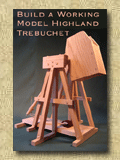
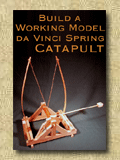
The Stone Throwing Ballista, da Vinci's Spring Catapult and The Highland
Trebuchet using parts and materials available from your local home center,
or hardware store.
The straightforward designs require no complicated layout or joinery
and include:
-
A Complete Parts and Materials Shopping List
-
Measured Drawings and Dimensions for All Individual Parts
-
Step-by-Step Assembly Drawings
-
Step-by-Step Assembly Instructions
-
Detailed Construction Notes
-
Step-by-Step Firing and Tuning Instructions
-
A Photo of the Completed Catapult
|
| Working Model Trebuchet Kit |
 |
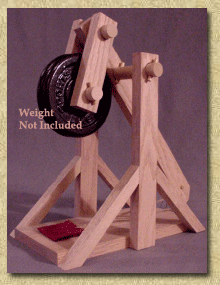 Trebuchet
Kit
Trebuchet
Kit
TK1
|
$75.00
FREE Shipping
U.S. Orders Only |

|
|
|
The trebuchet kit includes fully precut and drilled
frame parts, pins and axles, sling cord and sewn pouch, projectiles and
fully illustrated assembly and firing instructions.
Unlike the flimsy, snap together plywood trebuchet
kits, our all hardwood trebuchet kit does not require additional cutting,
trimming or shaping.
Requires only white carpenter's glue and a few
bar clamps (not included) to assemble.
Read
More >> |
Build a Trebuchet From Plans
 |
|
-
Materials Shopping List
-
Complete Parts List
-
Measured Drawings for All Parts
-
Step-By-Step Assembly Drawings
-
Construction Details and Notes
-
How a Trebuchet Works
-
Illustrated Firing Instructions
-
Illustrated Tuning Instructions
-
Picture of the Completed Trebuchet
|
| Fully Assembled Working Models |
|
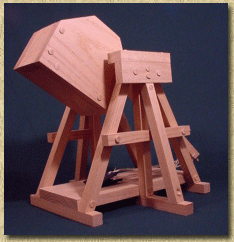
daVinci
Trebuchet
T4 |
$299.00
FREE Shipping
U.S. Orders Only
|
|
| |
|
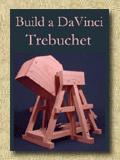
Inspired by the great war machines and siege catapults of Leonardo da Vinci
, this all Red Oak
hardwood trebuchet features
an open counterweight cabinet for range and trajectory adjustment.
Individually crafted from cabinet-grade red oak, the da Vinci Trebuchet
stands 14 inches tall in the cocked position, 24 inches tall in the fired
position and will hurl a projectile up to 60 feet. Includes six projectiles
and fully illustrated instructions.
Read
More >> |
|