|
Chapter LVII
The Ballista, Its Construction and Management
The ballista projected heavy arrows of a size proportionate to its power
and not stones, though it was frequently alluded to by ancient and mediaeval
writers as a stone-throwing engine.
This mistake arose from the fact that the names balista and catapult
were often used indiscriminately in accounts of battles and sieges.
The projectile force of the ballista, as in the catapult, was obtained
from tightly twisted cordage formed of horse-hair or of the sinews from
the necks of large animals, such as horses and oxen.1
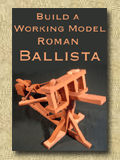
The construction of the ballista resembled two catapults with their
arms connected by a thick rope, this rope forming the bow-string of the
engine. In appearance the balista was like an immense crossbow, and it
doubtless suggested the invention of the crossbow or manubalista carried
by the mediaeval soldier.
The marked difference between the balista and the crossbow was, that
the bow of the ballista consisted of two pieces or arms, - each arm being
worked by its separate skein of twisted cord, - while the bow of the crossbow
was always made in one length.
In the balista, each arm of its bow worked independently. In the crossbow,
the arms of the bow acted, of course, as one piece.
The catch which secured the stretched bow-string of the military crossbow
was similar to the catch that held the string of the ballista ; the lock
of the crossbow, as regards its tumbler and long trigger, being closely
copied from that of the balista.
The windlass which pulled back the bow-string of the balista was probably
the original of the small windlass used for the thick steel bow of the
fifteenth century crossbow.
Though mediaeval authors sometimes write of this engine as if it had
a gigantic bow in one piece, I can find no evidence that such a bow was
fitted to the ballista.
1 See footnote, p. 64.
|