|
|
The
Crossbow > Chapter 1
> Military Crossbow >
p.9
The Military Crossbow
the approach to its gateway. A crossbow could be strung in , and discharged
from, a room not 6 feet high to the ceiling, whilst a longbowman required
a height of at least 7 feet in order to shoot an arrow with effect.
Nor did the crossbow require the strength,
skill and practice to manipulate it that were so necessary in the case
of the longbow.
The narrow cruciform loophole, called by architects "Arbalestina," which
is usually to be seen in the masonry of a mediaeval fortress, was designed
for the special use of crossbowmen in repelling an assault.
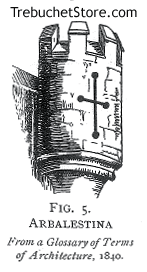
Fig 5. - Arbalestina
From the Glossary of Terms of Architechure, 1840
To enable the crossbow, or longbow, to be aimed
to the right or left through a loophole, the aperture was greatly widened
out on the inside face of the perforated wall.
The perpendicular loopholes, also common in ancient castles, were intended
for the archer with his longbow, hence they were not cruciform in outline1.
The perfected military crossbow of the fifteenth
century, with its steel bow and appendages, being heavy, and slow in action,
could not be utilised so readily for shooting quickly at single combatants,
or at small bodies of men and horse on the open field of battle, as could
the longbow. Its weight alone precluded it from being aimed with success
against rapidly moving objects, nor could its bolt be directed with precision
if a hurried aim was taken.
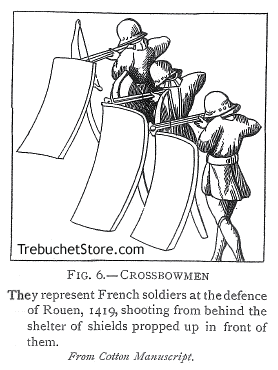
Fig 6 - Crossbowmen
They represent French soldiers at the defence of Rouen,
1419, shooting from behind the shelter of shields propped up in front of
them.
On the other hand, a skilful archer with his longbow might quite possibly
pierce a galloping stag with an arrow at a distance of 70 yards, and, if
he failed to strike his mark, send another shaft at his quarry before it
was out of bow-shot.2
This advantage of rapid aiming and shooting, the longbowman could apply
1 ' Our Chateau de Cheeignee we have assigned
to the Earl of Montfort in such wise that he is to understand we cannot
allow in it any perpendicular loophole for archers, nor any cruciform loophole
for crossbow-men.' - From a Royal Charter of France dated 1239 and quoted
in Sir S. Meyrick's work on Ancient Armour.
2 If an archer expected to use two arrows in
rapid succession, he held his second arrow against the back of his bow
with his left hand, or else pressed into the palm of the right hand by
the thumb, so that he could instantly seize it and fit it to his bow-string,
and thus save the time that would otherwise be spent in extracting it from
a quiver. On the other hand the crossbowman, when bending his bow, held
a bolt between his teeth, so that it might be ready to fit to his weapon
without any delay. Pages 49, 124.
The Crossbow
> Chapter 1 > Military
Crossbow > p.9
|
Save up to 50% with Multi-Plan Deals
|
2 Plans $19.95 FREE Shipping
- Save Over 30%
U.S. Orders Only |
|
Get a Book of Catapult and Trebuchet Plans
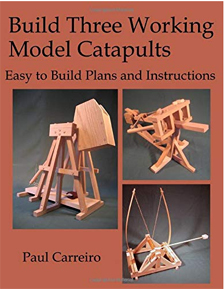
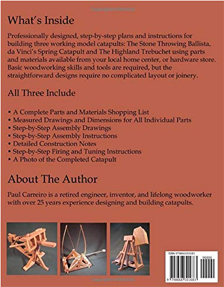
Book of Catapult Plans
On Amazon.com
"Build Three Working Model Catapults, Easy to Build Plans
and Instructions"
|
 Build Three Working Model
Catapults, Easy to Build Plans and Instructions is ideal for anyone
looking to build authentic, working model catapults.
Build Three Working Model
Catapults, Easy to Build Plans and Instructions is ideal for anyone
looking to build authentic, working model catapults.
This book contains professionally designed, step-by-step plans and instructions
for building three working model catapults:
The Stone Throwing Ballista, da Vinci's Spring Catapult and The Highland
Trebuchet using parts and materials available from your local home center,
or hardware store.
The straightforward designs require no complicated layout or joinery
and include:
-
A Complete Parts and Materials Shopping List
-
Measured Drawings and Dimensions for All Individual Parts
-
Step-by-Step Assembly Drawings
-
Step-by-Step Assembly Instructions
-
Detailed Construction Notes
-
Step-by-Step Firing and Tuning Instructions
-
A Photo of the Completed Catapult
|
| Working Model Trebuchet Kit |
 |
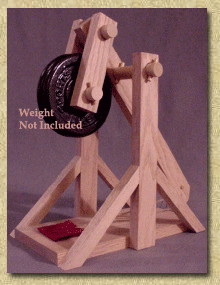 Trebuchet
Kit
Trebuchet
Kit
TK1
|
$75.00
FREE Shipping
U.S. Orders Only |

|
|
|
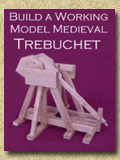
The trebuchet kit includes fully precut and drilled
frame parts, pins and axles, sling cord and sewn pouch, projectiles and
fully illustrated assembly and firing instructions.
Unlike the flimsy, snap together plywood trebuchet
kits, our all hardwood trebuchet kit does not require additional cutting,
trimming or shaping.
Requires only white carpenter's glue and a few
bar clamps (not included) to assemble.
Read
More >> |
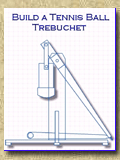
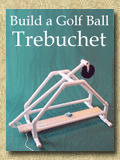
Build a Trebuchet From Plans
 |
|
-
Materials Shopping List
-
Complete Parts List
-
Measured Drawings for All Parts
-
Step-By-Step Assembly Drawings
-
Construction Details and Notes
-
How a Trebuchet Works
-
Illustrated Firing Instructions
-
Illustrated Tuning Instructions
-
Picture of the Completed Trebuchet
|
Build a Trebuchet From Plans
|
|
-
Materials Shopping List
-
Complete Parts List
-
Measured Drawings for All Parts
-
Step-By-Step Assembly Drawings
-
Construction Details and Notes
-
How a Trebuchet Works
-
Illustrated Firing Instructions
-
Illustrated Tuning Instructions
-
Picture of the Completed Trebuchet
|
| Fully Assembled Working Models |
|
daVinci
Trebuchet
T4 |
$299.00
FREE Shipping
U.S. Orders Only
|
|
| |
|
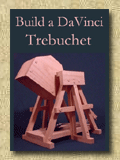
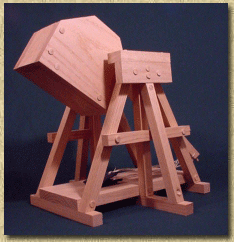
Inspired by the great war machines and siege catapults of Leonardo da Vinci
, this all Red Oak
hardwood trebuchet features
an open counterweight cabinet for range and trajectory adjustment.
Individually crafted from cabinet-grade red oak, the da Vinci Trebuchet
stands 14 inches tall in the cocked position, 24 inches tall in the fired
position and will hurl a projectile up to 60 feet. Includes six projectiles
and fully illustrated instructions.
Read
More >> |
|