|
The Crossbow
The after-end of the sighting strip (fig. 47, previous page), it will
be seen, is cut away for a length of 3 in. and a depth of 1/4 in. This
was to allow the sheath of the windlass to be fitted over the end of the
stock, fig. 73, p. 120 (upper plan).
The stock was covered at its end with a cap of thin metal for a length
of 2 in., to protect it from the friction of the sheath of the windlass,
A, fig. 47, previous page.
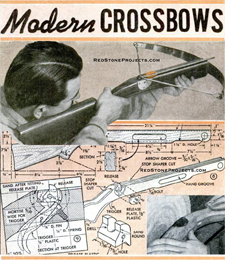
In the case of crossbows with long stocks, such as those bent with a
windlass and its ropes, as here described, the small or pointed end of
the stock (known as the tiller) was either squeezed tight inside the right
armpit, or was rested for a few inches on the top of the right shoulder.
The left hand grasped the enlarged part of the under surface of the stock,
and the left elbow rested on the left hip or against the left side, in
order to support the weapon in a horizontal position. The fingers of the
right hand were thus free to work the trigger, and the right thumb to act
as a back-sight The face was inclined over the stock, so as to bring the
right eye in line with the groove in which the bolt was laid, fig. 36,
p. 78.
Louis XI. of France, 1461-1483, issued a military order that crossbowmen
in his army should have the vizors of their helmets cut away on the right
side opposite the cheek, so that the vizor might not interfere with the
stock of the crossbow when the crossbowman was taking aim.
The sporting crossbows with short straight stocks, such as those bent
with a cranequin (fig. 87, p. 135), were held just clear of the shoulder,
those with enlarged butt-ends being placed against the top of the shoulder. |