|
The Crossbow
The nut and its socket should be of steel, and turned in a lathe to
fit each other exactly, so that the nut may revolve accurately and closely
in its socket.
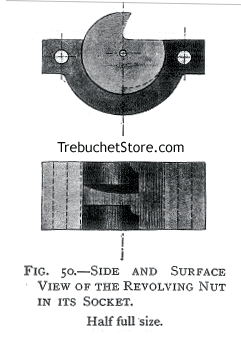
Fig. 50. - Side and Surface View of the Revolving Nut
in Its Socket. Half full size.
The nut is 1 1/2 in. diameter and 1 1/4 in. thick. In outline the nut
is, of course, a circle. The socket in which it revolves, is 1/4
in. more than a half circle, so as to bring the centre-hole of the nut
1/4 in. below the surface of the socket, and also of the stock of
the crossbow,1 as shown in fig. 50.
The pin (1/8 in. diameter) which passes through the 3/16 in. hole
in the centre of the nut, and also through the lock-plates, is merely intended,
without receiving any pressure, to hold the nut in its position in the
socket.
The socket should take all the pressure of the nut when the bow-string
is stretched over the fingers of the latter, and for this reason the pin
is slightly smaller than the hole in the centre of the nut. If any strain
came upon the pin which passes through the nut, it would bend and the nut
would not then revolve.
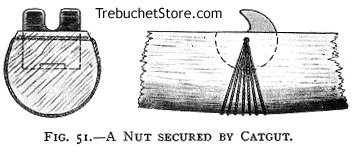
Fig. 51. - A Nut Secured by Catgut.
In many mediaeval crossbows, the pin through the nut was omitted, though
sometimes present in the form of a thin length of catgut passed several
times through the hole in the nut, and then round the stock, just to prevent
the nut from falling out of its socket and being lost, fig. 51. More often,
however, the nut, being only of horn, was not weakened by having a hole
bored through its centre, but was held in its socket by two little screw-pins,
one through each lock-plate, neither of which pins penetrated the opposite
centres of the nut more than 1/4 in., fig. 52.
1 This prevents the pin which passes through
the nut from being too near the upper edge of the stock. It also gives
the revolving nut more 'centre bearing' against its socket to withstand
the strain of the bow-string. |