|
|
The
Crossbow > Chapter 5
> Range of the Medieval Crossbow
> p.23
The Range of the Medieval Crossbow
of ordinary length, can rarely exceed a range of 280 to 290 yards, though
a distance of 320 to 340 yards has on two or three occasions been recorded
; Roberts, the author of ' The English Bowman,' even writes of a shot of
360 yards which he was informed occurred in 1798, but which was made, however,
on declining ground.
In the days when the longbow was at its best,
and was the national weapon of the English in war and sport, every man
and youth, rich or poor, who could bend a bow, constantly practised archery.
That some of the great number of archers continually shooting with the
longbow, would be able to surpass considerably the ordinary bowman
of the period in feats of range and marksmanship, was of course likely.
I am convinced, however, that none of these exceptional performers ever
shot the mediaeval arrow used in warfare, sport or at the target, a distance
of 420 yards. I doubt if a range of even 390 yards was ever attained by
an English longbowman, unless with the aid of a strong wind, or from an
elevation.
Many of our castles which were built in the days when archery nourished,
and before the introduction of long-range steel crossbows, are within 300
to 350 yards of eminences. The courtyard of the great castle of Carnarvon,
for instance, is commanded by a hill only 330 yards distant from it.
If medieval archers shot from 350 to 400 yards, as they are often alleged
to have been able to do easily, Carnarvon Castle would never have been
built where it is ; as a company of bowmen could have poured their shafts
into its garrison from the hill that overlooks the fortress.
Berkeley Castle is another example The parish church at Berkeley is
within 50 yards of the castle keep. Its church tower, however, stands by
itself, 134 yards from the centre of the keep, and 170 yards from the courtyard
of the castle. It was erected at a distance from the body of the church,
in order to prevent the archers of an enemy from annoying the garrison
of the castle should they happen to seize the tower as a point of vantage.
There is, indeed, no other reason for the isolated position of the church
tower at Berkeley.
In this case, it will be noticed that a much shorter range than that
at Carnarvon was considered to be a safe one against the assaults of bowmen.
Even in modern days, the feats of shooting with the medieval
longbow are asserted to have been of such a marvellous nature, that
the writers not only excite ridicule among those versed in archery, but
too plainly show their ignorance of the arm.
Sir Walter Scott (' Ivanhoe') is certainly a culprit in this respect,
with his accounts of the piercing of willow wands, and of an archer purposely
splitting a rival's arrow when it was fixed in the target.
The Crossbow
> Chapter 5 > Range
of the Medieval Crossbow > p.23
|
Save up to 50% with Multi-Plan Deals
|
2 Plans $19.95 FREE Shipping
- Save Over 30%
U.S. Orders Only |
|
Get a Book of Catapult and Trebuchet Plans
Book of Catapult Plans
On Amazon.com
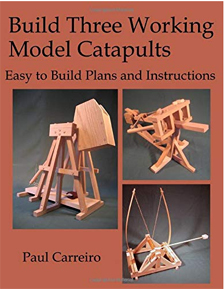
"Build Three Working Model Catapults, Easy to Build Plans
and Instructions"
|
 Build Three Working Model
Catapults, Easy to Build Plans and Instructions is ideal for anyone
looking to build authentic, working model catapults.
Build Three Working Model
Catapults, Easy to Build Plans and Instructions is ideal for anyone
looking to build authentic, working model catapults.
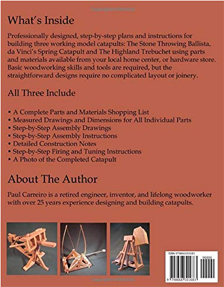
This book contains professionally designed, step-by-step plans and instructions
for building three working model catapults:
The Stone Throwing Ballista, da Vinci's Spring Catapult and The Highland
Trebuchet using parts and materials available from your local home center,
or hardware store.
The straightforward designs require no complicated layout or joinery
and include:
-
A Complete Parts and Materials Shopping List
-
Measured Drawings and Dimensions for All Individual Parts
-
Step-by-Step Assembly Drawings
-
Step-by-Step Assembly Instructions
-
Detailed Construction Notes
-
Step-by-Step Firing and Tuning Instructions
-
A Photo of the Completed Catapult
|
| Working Model Trebuchet Kit |
 |
 Trebuchet
Kit
Trebuchet
Kit
TK1
|
$75.00
FREE Shipping
U.S. Orders Only |

|
|
|
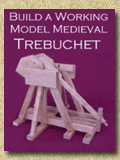
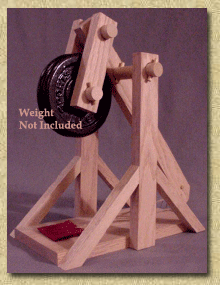
The trebuchet kit includes fully precut and drilled
frame parts, pins and axles, sling cord and sewn pouch, projectiles and
fully illustrated assembly and firing instructions.
Unlike the flimsy, snap together plywood trebuchet
kits, our all hardwood trebuchet kit does not require additional cutting,
trimming or shaping.
Requires only white carpenter's glue and a few
bar clamps (not included) to assemble.
Read
More >> |
Build a Trebuchet From Plans
 |
|
-
Materials Shopping List
-
Complete Parts List
-
Measured Drawings for All Parts
-
Step-By-Step Assembly Drawings
-
Construction Details and Notes
-
How a Trebuchet Works
-
Illustrated Firing Instructions
-
Illustrated Tuning Instructions
-
Picture of the Completed Trebuchet
|
| Fully Assembled Working Models |
|
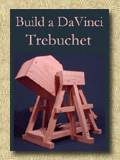
daVinci
Trebuchet
T4 |
$299.00
FREE Shipping
U.S. Orders Only
|
|
| |
|
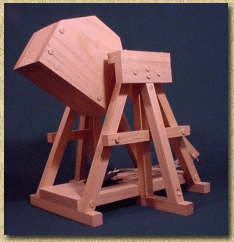
Inspired by the great war machines and siege catapults of Leonardo da Vinci
, this all Red Oak
hardwood trebuchet features
an open counterweight cabinet for range and trajectory adjustment.
Individually crafted from cabinet-grade red oak, the da Vinci Trebuchet
stands 14 inches tall in the cocked position, 24 inches tall in the fired
position and will hurl a projectile up to 60 feet. Includes six projectiles
and fully illustrated instructions.
Read
More >> |
|