|
|
The
Crossbow > Chapter 5
> Range of the Medieval Crossbow
> p.22
The Crossbow
it is curious to note, is just the range that can be reached by an unusually
strong and skilful archer of the present day.
The Crossbows for Killing Deer - such as the one described in
Chapters XVIII-XXVIII - were somewhat lighter and less powerful than those
intended for war, their bolts being of course also smaller.
I find that these sporting crossbows send
their bolts at furthest 350 yards, their average length of flight being
from 330 to 340 yards. The point-blank range, so called, of a good sporting
crossbow, with a steel bow, was from 50 to 60 yards, which was no doubt
sufficient in the days before animals had been made wary by the report
of handguns, and when the hunter with his noiseless crossbow, could lie
in wait for deer as they wandered across the glades of a forest, or visited
their feeding and drinking haunts.
The extreme range of the Smaller Sporting Crossbow
(Chapter XXXII), which shot a light poisoned
bolt, was from 270 to 280 yards.
In the ' Dunstable Chronicle' Henry V. is described as approaching the
town of Rouen ' within a distance of 40 rods or within shot of a quarrel
from a crossbow.' Forty rods is 220 yards, and 'within shot of a quarrel'
suggests the range of a quarrel to be further than 220 yards. This distance,
however, doubtless implies merely a shot with an effective aim, and not
one made to test the extreme range of a crossbow, which would certainly
be far more than 220 yards when the weapon was pointed upwards at a high
angle.
I have never been able to test a crossbow with a composite bow of horn,
yew, and sinew, but this variety must necessarily have been much inferior
in power to a crossbow with a thick steel bow.
There are few weapons with composite bows in existence, and these are in
such a dilapidated condition that no experiments can be made with them.
It may be taken that the ordinary longbowmen of the days of Crecy and
Agincourt, could not shoot the heavy-headed war arrow to a greater range
than about 250 yards.1
Whether the English bowman of the fifteenth century could shoot his
lighter arrows further than a flight arrow can be propelled by an accomplished
archer of the present day, is doubtful, particularly when we consider that
it is not one bow in a score that will shoot a flight arrow successfully.
For instance, I have bows of 75 to 80 Lbs. with which I can draw a 30 in.
flight arrow to the head, but which at the same time do not drive it nearly
so far as a bow with a pull of only 60 Lbs.
As I have pointed out, the skilled modern archer, with a flight arrow
1 It is true the English bowmen sometimes carried
several arrows with much lighter heads and shafts than the others in their
sheaves. They used these to harass an enemy, and especially his horses,
at a distance which was beyond the reach of the ordinary, and heavier war
arrow. Though these lighter arrows probably, in some degree, resembled
modern flight, or roving arrows, they must have had heavier heads than
the latter to have been of any use in warfare.
The Crossbow
> Chapter 5 > Range
of the Medieval Crossbow > p.22
|
Save up to 50% with Multi-Plan Deals
|
2 Plans $19.95 FREE Shipping
- Save Over 30%
U.S. Orders Only |
|
Get a Book of Catapult and Trebuchet Plans
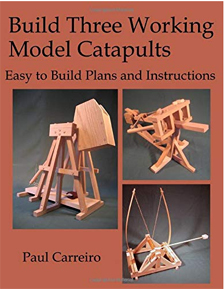
Book of Catapult Plans
On Amazon.com
"Build Three Working Model Catapults, Easy to Build Plans
and Instructions"
|
 Build Three Working Model
Catapults, Easy to Build Plans and Instructions is ideal for anyone
looking to build authentic, working model catapults.
Build Three Working Model
Catapults, Easy to Build Plans and Instructions is ideal for anyone
looking to build authentic, working model catapults.
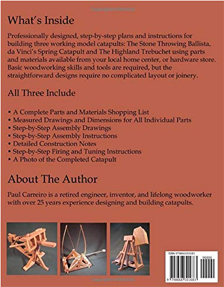
This book contains professionally designed, step-by-step plans and instructions
for building three working model catapults:
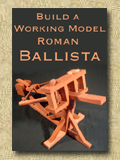
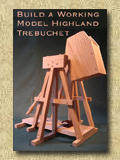
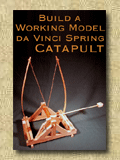
The Stone Throwing Ballista, da Vinci's Spring Catapult and The Highland
Trebuchet using parts and materials available from your local home center,
or hardware store.
The straightforward designs require no complicated layout or joinery
and include:
-
A Complete Parts and Materials Shopping List
-
Measured Drawings and Dimensions for All Individual Parts
-
Step-by-Step Assembly Drawings
-
Step-by-Step Assembly Instructions
-
Detailed Construction Notes
-
Step-by-Step Firing and Tuning Instructions
-
A Photo of the Completed Catapult
|
| Working Model Trebuchet Kit |
 |
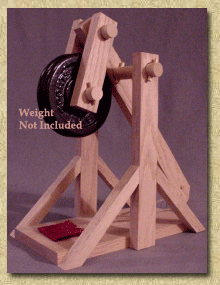 Trebuchet
Kit
Trebuchet
Kit
TK1
|
$75.00
FREE Shipping
U.S. Orders Only |

|
|
|
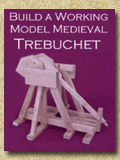
The trebuchet kit includes fully precut and drilled
frame parts, pins and axles, sling cord and sewn pouch, projectiles and
fully illustrated assembly and firing instructions.
Unlike the flimsy, snap together plywood trebuchet
kits, our all hardwood trebuchet kit does not require additional cutting,
trimming or shaping.
Requires only white carpenter's glue and a few
bar clamps (not included) to assemble.
Read
More >> |
Build a Trebuchet From Plans
 |
|
-
Materials Shopping List
-
Complete Parts List
-
Measured Drawings for All Parts
-
Step-By-Step Assembly Drawings
-
Construction Details and Notes
-
How a Trebuchet Works
-
Illustrated Firing Instructions
-
Illustrated Tuning Instructions
-
Picture of the Completed Trebuchet
|
| Fully Assembled Working Models |
|
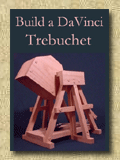
daVinci
Trebuchet
T4 |
$299.00
FREE Shipping
U.S. Orders Only
|
|
| |
|
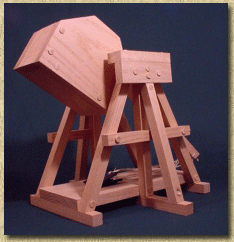
Inspired by the great war machines and siege catapults of Leonardo da Vinci
, this all Red Oak
hardwood trebuchet features
an open counterweight cabinet for range and trajectory adjustment.
Individually crafted from cabinet-grade red oak, the da Vinci Trebuchet
stands 14 inches tall in the cocked position, 24 inches tall in the fired
position and will hurl a projectile up to 60 feet. Includes six projectiles
and fully illustrated instructions.
Read
More >> |
|