|
|
The
Crossbow > Chapter 5
> Range of the Medieval Crossbow
> p.30
The Crossbow
If they are correct, they can only be accounted for by the use of a
light short arrow, a very powerful bow, great strength and skill, and,
above all else, by the horn appendage which the Turkish archer attached
to his left arm, and without which he could not shoot so short an arrow
from his bow.1
If a very light flight arrow of reed or bamboo could in some way be
arranged to receive the impulse of the thick string
of a crossbow with a powerful steel bow, I have little doubt it could
be propelled half a mile.
I have fitted (as a separate piece) a large hollow horn nock over the
butt of the ordinary flight arrow of the longbow, so that the loose nock
rested against the string of the crossbow.
In this way I have obtained several flights of from 500 yards to 515 yards.
In the case of a short and very light flighting arrow, however, the recoil
of the steel bow shivers it to pieces as it leaves the stock
of the crossbow.
1 Even if we accept only the shortest range
recorded on the columns as correct - i.e. 625 yards - it is an extraordinary
distance for any arrow to be propelled, and much exceeds, as far as we
know, what has ever been done by an English bowman with a longbow. It is,
however, beyond question that the secretary to the Turkish Ambassador did
shoot an arrow 482 yards (the arrow and bow being even now preserved in
the Toxophilite Society's rooms), though he declared at the time of the
occurrence that he was not proficient in the art of sending a flight arrow
to what he considered a great distance. We may from this safely assume
that a range of 143 yards further than the Turkish secretary attained with
his bow, or a total flight of 625 yards, was quite possible in the case
of a more powerful and skilled Turkish archer than he was.
See Chapter L. for a description
of long distance arrow throwing by hand.
The Crossbow
> Chapter 5 > Range
of the Medieval Crossbow > p.30
|
Save up to 50% with Multi-Plan Deals
|
2 Plans $19.95 FREE Shipping
- Save Over 30%
U.S. Orders Only |
|
Get a Book of Catapult and Trebuchet Plans
Book of Catapult Plans
On Amazon.com
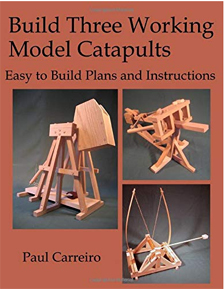
"Build Three Working Model Catapults, Easy to Build Plans
and Instructions"
|
 Build Three Working Model
Catapults, Easy to Build Plans and Instructions is ideal for anyone
looking to build authentic, working model catapults.
Build Three Working Model
Catapults, Easy to Build Plans and Instructions is ideal for anyone
looking to build authentic, working model catapults.
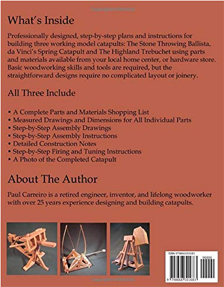
This book contains professionally designed, step-by-step plans and instructions
for building three working model catapults:
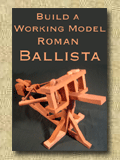
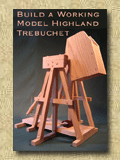
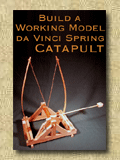
The Stone Throwing Ballista, da Vinci's Spring Catapult and The Highland
Trebuchet using parts and materials available from your local home center,
or hardware store.
The straightforward designs require no complicated layout or joinery
and include:
-
A Complete Parts and Materials Shopping List
-
Measured Drawings and Dimensions for All Individual Parts
-
Step-by-Step Assembly Drawings
-
Step-by-Step Assembly Instructions
-
Detailed Construction Notes
-
Step-by-Step Firing and Tuning Instructions
-
A Photo of the Completed Catapult
|
| Working Model Trebuchet Kit |
 |
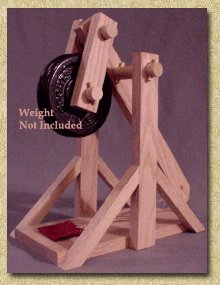 Trebuchet
Kit
Trebuchet
Kit
TK1
|
$75.00
FREE Shipping
U.S. Orders Only |

|
|
|
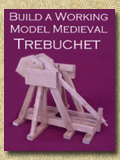
The trebuchet kit includes fully precut and drilled
frame parts, pins and axles, sling cord and sewn pouch, projectiles and
fully illustrated assembly and firing instructions.
Unlike the flimsy, snap together plywood trebuchet
kits, our all hardwood trebuchet kit does not require additional cutting,
trimming or shaping.
Requires only white carpenter's glue and a few
bar clamps (not included) to assemble.
Read
More >> |
Build a Trebuchet From Plans
 |
|
-
Materials Shopping List
-
Complete Parts List
-
Measured Drawings for All Parts
-
Step-By-Step Assembly Drawings
-
Construction Details and Notes
-
How a Trebuchet Works
-
Illustrated Firing Instructions
-
Illustrated Tuning Instructions
-
Picture of the Completed Trebuchet
|
| Fully Assembled Working Models |
|
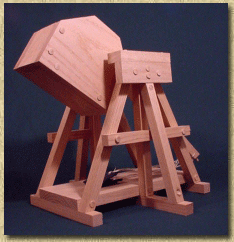
daVinci
Trebuchet
T4 |
$299.00
FREE Shipping
U.S. Orders Only
|
|
| |
|
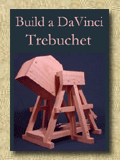
Inspired by the great war machines and siege catapults of Leonardo da Vinci
, this all Red Oak
hardwood trebuchet features
an open counterweight cabinet for range and trajectory adjustment.
Individually crafted from cabinet-grade red oak, the da Vinci Trebuchet
stands 14 inches tall in the cocked position, 24 inches tall in the fired
position and will hurl a projectile up to 60 feet. Includes six projectiles
and fully illustrated instructions.
Read
More >> |
|