|
Chapter XLIX
The Chinese Repeating Crossbow
Here we have surely the most curious of all the weapons I have described.
Though the antiquity of the repeating crossbow
is so great that the date of its introduction is beyond conjecture, it
is to this day carried by Chinese soldiers in the more remote districts
of their empire.
In the recent war between China and Japan, 1894-95, the repeating crossbow
was frequently seen among troops who came from the interior of the first-named
country.
The interesting and unique feature of this crossbow is its repeating
action, which though so crudely simple acts perfectly and enables the crossbowman
to discharge ten arrows in fifteen seconds.
When bows, and crossbows which shot one bolt at a time, were the usual
missive weapons of the Chinese, it is probable that the repeating crossbow
was very effective for stopping the rush of an enemy in the open, or for
defending fortified positions.
For example, one hundred men with repeating
crossbows could send a thousand arrows into their opponents' ranks
in a quarter of a minute.
On the other hand, one hundred men with bows, or with ordinary crossbows
that shot only one arrow at a discharge, would not be able to loose more
than about two hundred arrows in fifteen seconds.
The effect of a continuous stream of a thousand arrows flying into a
crowd of assailants - in so short a space as fifteen seconds - would, of
course, be infinitely greater than that of only two hundred in the same
time, especially as the arrows of barbaric nations were often smeared with
poison.
The small and light arrow of the comparatively weak Chinese
crossbow here described had little penetrative power. For this reason
the head of the arrow was sometimes dipped in poison, in order that a slight
wound might prove fatal.
The impetus of the heavy bolt of the medieval
European crossbow which had a thick steel bow, was sufficient to destroy
life without the aid of such a cruel accessory as poison.
| Repeating Crossbow |
$12.95
FREE Shipping
|

|
|
|
 Repeating
Crossbow Plans Repeating
Crossbow Plans
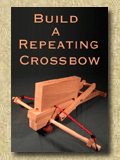
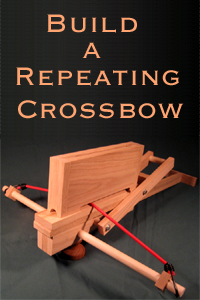
Build a Repeating Crossbow with our easy, step by step plans and instructions.
When complete, the repeating crossbow measures 32 inches long and will
fire up to 10 bolts in as little as 8 seconds without reloading.
Professional Design
Based on the ancient Chinese Repeating Crossbow, our crossbow uses modern
materials, including a bungee cord for a bow, to ease construction while
maintaining a historically correct mechanism and action.
Easy to Build
All TrebuchetStore.com
plans use common, inexpensive and easy to find building materials, available
at your local hardware store or home center. Basic skills and tools are
required, but the straightforward designs require no complicated layout
or joinery.
The Repeating Crossbow plans come complete with:
-
Parts Shopping List
-
Measured Drawings for all parts
-
Assembly Drawings
-
Step by Step Assembly Instructions
-
Step by Step Operating Instructions
All the information you need to complete your project quickly and easily. |
The Crossbow
> Chapter 49 > The Chinese Repeating
Crossbow > p.237 |