|
|
The
Crossbow > Chapter 6
> Shortbow , Longbow and Crossbow
> p.32
The Crossbow
The longbow held its own, as by far the most
deadly manual missive weapon in warfare, till about 1370, when the crossbow
with its thick steel bow and powerful windlass
was introduced.
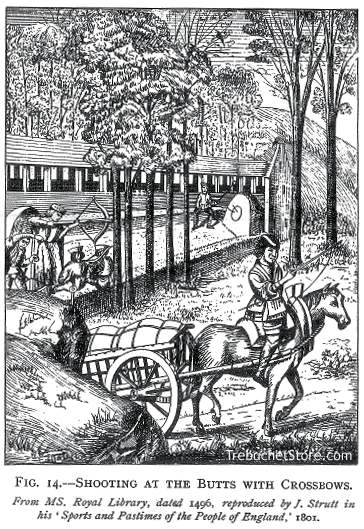
Fig. 14. - Shooting at the Butts with Crossbows.
The shortbow, the ancient form of bow, though
carried by foot-soldiers in early mediaeval times, was more often the arm
of mounted men, especially abroad. Being short, it could conveniently be
discharged from horseback, and when not in use it could be slung over the
back of the soldier with its cord across his breast. The string of the
shortbow was drawn to the breast, and not to the right ear as in the longbow.
The longbow could not be used on horseback, but in the hands of footmen
it was an infinitely more powerful arm than its predecessor, the shortbow.
With the English, the longbow, which was never popular abroad, gradually
usurped the place of the shortbow. In the assize of arms fixed by Henry
II. in 1181, bows, whether short or long, are not even alluded to as weapons
of the period. It was only in the last quarter of the thirteenth century,
1272 - 1300, during the reign of Edward I., that with English troops the
longbow became a popular weapon, and in great measure superseded the short-bow
and the primitive crossbow. Subsequent to about
the year 1340, English soldiers carried longbows only, and never, or very
seldom, crossbows. After the successes of the English longbowmen at Falkirk
in 1298 - the first notable triumph recorded of these weapons - and especially
after the splendid victory gained by their assistance at Crecy in 1346,
and again at Poitiers in 1356, and at Agincourt in 1415, our ancestors
naturally despised the crossbow as a military
weapon.1
1 The contemporary French chroniclers of the
battle of Crecy, allude to the English longbow as being at that time a
new and deadly weapon in Continental warfare.
The Crossbow
> Chapter 6 > Shortbow
, Longbow and Crossbow > p.32
|
Save up to 50% with Multi-Plan Deals
|
2 Plans $19.95 FREE Shipping
- Save Over 30%
U.S. Orders Only |
|
Get a Book of Catapult and Trebuchet Plans
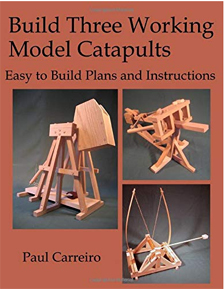
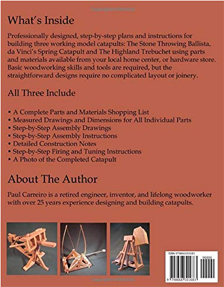
Book of Catapult Plans
On Amazon.com
"Build Three Working Model Catapults, Easy to Build Plans
and Instructions"
|
 Build Three Working Model
Catapults, Easy to Build Plans and Instructions is ideal for anyone
looking to build authentic, working model catapults.
Build Three Working Model
Catapults, Easy to Build Plans and Instructions is ideal for anyone
looking to build authentic, working model catapults.
This book contains professionally designed, step-by-step plans and instructions
for building three working model catapults:
The Stone Throwing Ballista, da Vinci's Spring Catapult and The Highland
Trebuchet using parts and materials available from your local home center,
or hardware store.
The straightforward designs require no complicated layout or joinery
and include:
-
A Complete Parts and Materials Shopping List
-
Measured Drawings and Dimensions for All Individual Parts
-
Step-by-Step Assembly Drawings
-
Step-by-Step Assembly Instructions
-
Detailed Construction Notes
-
Step-by-Step Firing and Tuning Instructions
-
A Photo of the Completed Catapult
|
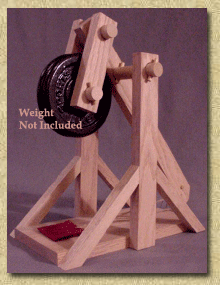
| Working Model Trebuchet Kit |
 |
 Trebuchet
Kit
Trebuchet
Kit
TK1
|
$75.00
FREE Shipping
U.S. Orders Only |

|
|
|
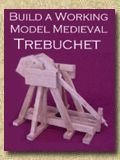
The trebuchet kit includes fully precut and drilled
frame parts, pins and axles, sling cord and sewn pouch, projectiles and
fully illustrated assembly and firing instructions.
Unlike the flimsy, snap together plywood trebuchet
kits, our all hardwood trebuchet kit does not require additional cutting,
trimming or shaping.
Requires only white carpenter's glue and a few
bar clamps (not included) to assemble.
Read
More >> |
Build a Trebuchet From Plans
 |
|
-
Materials Shopping List
-
Complete Parts List
-
Measured Drawings for All Parts
-
Step-By-Step Assembly Drawings
-
Construction Details and Notes
-
How a Trebuchet Works
-
Illustrated Firing Instructions
-
Illustrated Tuning Instructions
-
Picture of the Completed Trebuchet
|
| Fully Assembled Working Models |
|
daVinci
Trebuchet
T4 |
$299.00
FREE Shipping
U.S. Orders Only
|
|
| |
|
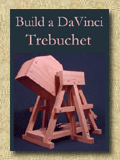
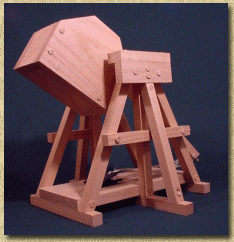
Inspired by the great war machines and siege catapults of Leonardo da Vinci
, this all Red Oak
hardwood trebuchet features
an open counterweight cabinet for range and trajectory adjustment.
Individually crafted from cabinet-grade red oak, the da Vinci Trebuchet
stands 14 inches tall in the cocked position, 24 inches tall in the fired
position and will hurl a projectile up to 60 feet. Includes six projectiles
and fully illustrated instructions.
Read
More >> |
|