|
|
The
Crossbow > Chapter 6
> Shortbow , Longbow and Crossbow
> p.37
Shortbow , Longbow
, and Crossbow
to withstand the powerful longbow, and suits of chain mail, or of light
plate, were almost useless as a defence against its arrow. It was only
when chain mail was discarded and plate armour was made heavier, that both
the arrow of the longbow, and the bolt of the crossbow
which had a thick steel bow, became less dangerous to knights and foot-soldiers.
A shower of two or three thousand arrows falling from aloft must have been
a terrifying sight, especially to a body of cavalry standing or moving
in close rank. Bullets from the primitive handgun had a comparatively low
trajectory and short range, and could not be detected as they passed through
the air. On the other hand, every soldier could see a cloud of arrows approaching
him, and he would surely imagine that one of the great number descending
must strike him.
Horses, too, were driven frantic by the English
bowmen, so we read, for their arrows caused the animals to rear and
plunge and gallop madly in all directions, thus throwing into dire confusion
any formation they were in. A bullet from a hand-gun might strike a horse,
and cause him to kick or plunge only at the moment of contact, but a barbed
arrow sticking deep in his flesh would, with every movement of the animal,
gall and fret him beyond the control of his rider, who would probably soon
be unhorsed, to become, if in heavy armour, an encumbrance on the field
for the remainder of the battle.
Various writers on archery and medieval
warfare, have asserted that the longbowman was able to discharge ten
to twelve arrows in the time taken by the crossbowman to shoot off one
bolt. But the crossbow was not nearly so slow as alleged, and experiments
I have made to test the question of its speed in shooting prove this. A
military crossbow of the fifteenth century, 15 Lb. in weight, can be
discharged at a mark once in a minute. The operation includes (1) Taking
the weapon from the shoulder. (2) Unhooking a windlass from a waist-belt.
(3) Fitting the windlass1 to the stock and string. (4) Winding
up the bow. (5) Arranging the bolt and, after taking aim, pressing the
trigger. I find that a longbow can be discharged six times at a target
in the space of one minute. The operation in this case also includes a
fair aim, besides taking the arrows from the ground, fitting them to the
string, and drawing and releasing the bow. I do not, however, imagine that
either the longbowman, or his rival with the crossbow, often used their
weapons in warfare with great rapidity, or their sheaves of arrows and
bolts would soon have been exhausted.
1 The cranequin, or ratchet-winder, Chapters
XXX., XXXI., though rather slower to use than a windlass, was, however,
far more convenient to manipulate, and also enabled a much smaller stock
to be fitted to a crossbow than was possible with a windlass and its cords.
For these reasons it was chiefly carried by mounted soldiers and by hunters
of deer.
The cranequin was introduced at a considerably later date
than the windlass, see p. 134
The Crossbow
> Chapter 6 >
Shortbow
, Longbow and Crossbow > p.37
|
Save up to 50% with Multi-Plan Deals
|
2 Plans $19.95 FREE Shipping
- Save Over 30%
U.S. Orders Only |
|
Get a Book of Catapult and Trebuchet Plans
Book of Catapult Plans
On Amazon.com
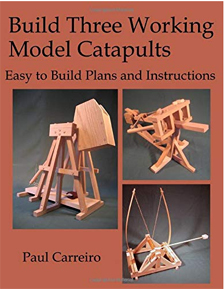
"Build Three Working Model Catapults, Easy to Build Plans
and Instructions"
|
 Build Three Working Model
Catapults, Easy to Build Plans and Instructions is ideal for anyone
looking to build authentic, working model catapults.
Build Three Working Model
Catapults, Easy to Build Plans and Instructions is ideal for anyone
looking to build authentic, working model catapults.
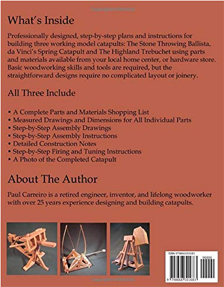
This book contains professionally designed, step-by-step plans and instructions
for building three working model catapults:
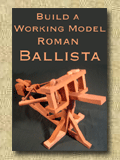
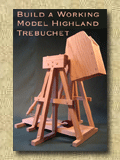
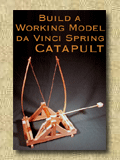
The Stone Throwing Ballista, da Vinci's Spring Catapult and The Highland
Trebuchet using parts and materials available from your local home center,
or hardware store.
The straightforward designs require no complicated layout or joinery
and include:
-
A Complete Parts and Materials Shopping List
-
Measured Drawings and Dimensions for All Individual Parts
-
Step-by-Step Assembly Drawings
-
Step-by-Step Assembly Instructions
-
Detailed Construction Notes
-
Step-by-Step Firing and Tuning Instructions
-
A Photo of the Completed Catapult
|
| Working Model Trebuchet Kit |
 |
 Trebuchet
Kit
Trebuchet
Kit
TK1
|
$75.00
FREE Shipping
U.S. Orders Only |

|
|
|
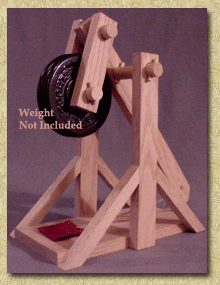
The trebuchet kit includes fully precut and drilled
frame parts, pins and axles, sling cord and sewn pouch, projectiles and
fully illustrated assembly and firing instructions.
Unlike the flimsy, snap together plywood trebuchet
kits, our all hardwood trebuchet kit does not require additional cutting,
trimming or shaping.
Requires only white carpenter's glue and a few
bar clamps (not included) to assemble.
Read
More >> |
Build a Trebuchet From Plans
 |
|
-
Materials Shopping List
-
Complete Parts List
-
Measured Drawings for All Parts
-
Step-By-Step Assembly Drawings
-
Construction Details and Notes
-
How a Trebuchet Works
-
Illustrated Firing Instructions
-
Illustrated Tuning Instructions
-
Picture of the Completed Trebuchet
|
| Fully Assembled Working Models |
|
daVinci
Trebuchet
T4 |
$299.00
FREE Shipping
U.S. Orders Only
|
|
| |
|
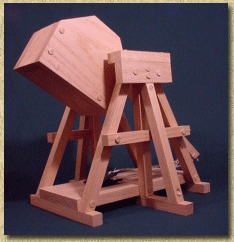
Inspired by the great war machines and siege catapults of Leonardo da Vinci
, this all Red Oak
hardwood trebuchet features
an open counterweight cabinet for range and trajectory adjustment.
Individually crafted from cabinet-grade red oak, the da Vinci Trebuchet
stands 14 inches tall in the cocked position, 24 inches tall in the fired
position and will hurl a projectile up to 60 feet. Includes six projectiles
and fully illustrated instructions.
Read
More >> |
|